
No matter how delicious your cookies are, weak or plain packaging can ruin a customer’s first impression. A cookie box isn’t just a covering — it’s the identity of your brand, and often the first thing a customer notices. This guide covers everything a bakery needs to choose the right cookie packaging: the box types, sizes, materials, gifting and eco ideas, and the design details that make cookies sell.
It matters even more for cookies because so many are bought as gifts. In an Ipsos survey for the Paper and Packaging Board, about 72% of US consumers said packaging design influences their buying decisions — and for gifts that rises to roughly 81%. Cookies are gift-heavy, so the box is doing a lot of the selling.
In This Guide
- Why cookie packaging matters
- Types of cookie boxes
- Cookie box sizes & how to choose
- Best materials
- Design, seasonal & gifting ideas
- Eco-friendly options & food safety
- Cost-effective packaging tips
- How & where to order
- Frequently asked questions
Why Cookie Packaging Matters
1. Freshness
Cookies quickly lose their crispiness or softness when exposed to air and moisture. Good packaging protects that texture:
- Air-tight or well-sealed packaging keeps cookies from going stale.
- Quality materials — food-grade board, foil-lined boxes, or resealable pouches — lock in flavor and texture for longer.
- Weak packaging lets in moisture, so cookies crumble or soften — which can stop a customer from ordering again.
2. Branding — the silent salesman
Packaging is the silent salesman of your business. Your logo, brand colors, and design build your identity in the customer’s mind, and when someone gifts your cookies or unboxes them on social media, attractive packaging becomes free marketing. Consistent branding — the same colors, fonts, and style on every box — creates a sense of trust and professionalism.
3. Gifting appeal
Cookies are one of the most gifted baked goods, from holidays and weddings to corporate hampers. Packaging that looks gift-worthy — a window, a ribbon, a rigid box — lets you charge more and reach an entirely different set of buyers than everyday retail.
Types of Cookie Boxes
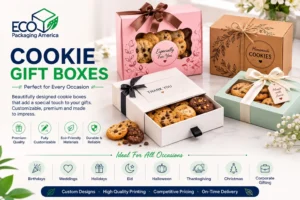
There’s a wide variety of cookie boxes, each designed for a purpose and customer need.

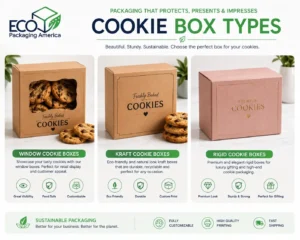
Window boxes
Window boxes have a clear (plastic or cellophane) cut-out so cookies are visible without opening the box. Customers see the product right away, which is why they’re the most popular option for bakeries and retail. The window’s size and shape — round, oval, or custom — can be adjusted to your brand.
Custom kraft boxes
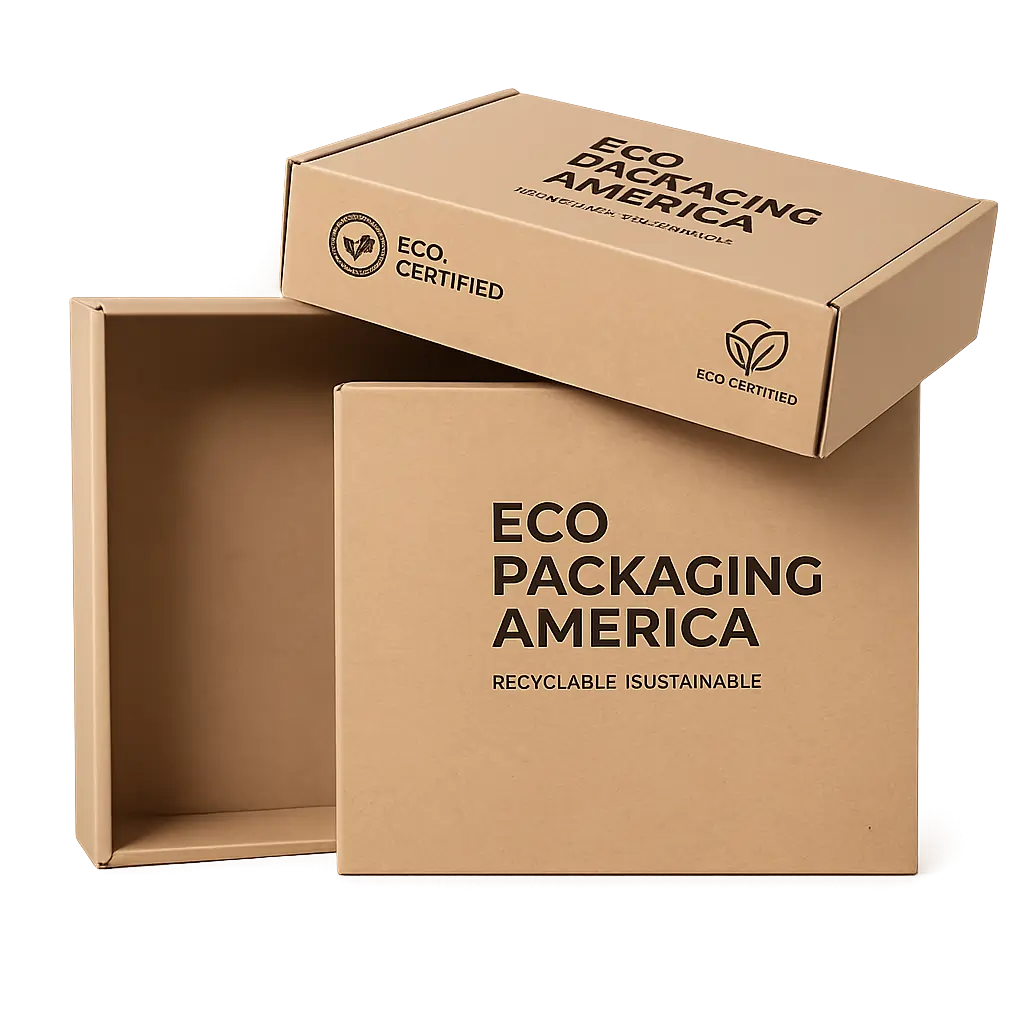
As customers become more environment-conscious, demand for kraft paper boxes is rising fast. They’re made from biodegradable, recyclable material, give a rustic, natural look that suits homemade or organic cookies, and are cost-effective — a great fit for small businesses and startups.
Rigid boxes
Rigid boxes are made from thick, sturdy board for a luxurious, premium feel. They’re ideal for special occasions — holiday, wedding, and corporate gifting boxes — and can be elevated with magnetic closures, ribbon handles, or embossed logos. Because they’re durable, customers often reuse them, keeping your brand in front of them for a long time.
Sleeve boxes
Sleeve boxes have two parts — an inner tray and an outer sliding sleeve — for a modern, minimalist look popular with trendy and boutique bakeries. The sleeve is easy to customize with printed designs or seasonal themes, and the sliding motion makes unboxing feel interactive, which is perfect for social content.
| Box Type | Best For | Cost | Premium Feel | Eco |
| Window | Retail display, impulse buys | Low–Med | Medium | Good |
| Kraft | Everyday, organic/artisan cookies | Low | Medium | Excellent |
| Rigid | Gifting, holidays, corporate | High | Very High | Good |
| Sleeve | Boutique, modern brands, social | Med | High | Good |
Cookie Box Sizes & How to Choose
Cookie boxes come in a range of pack sizes. The most in-demand are the 4, 6, and 12-count boxes: 4-count boxes are best-sellers for gifting and personal use, while the 12-count (dozen) is the standard for commercial bakeries.
| Pack Size | Best Use |
| 2-cookie box | Gift / sample size; single serving or trials |
| 4-cookie box | The most common size — gifting and retail |
| 6-cookie box | Family packs and small gatherings |
| 8-cookie box | Larger family size with a premium feel |
| 12-cookie box (dozen) | The bakery / commercial standard — best-seller |
| 24-cookie box | Bulk and party packaging for events |
Cookies are usually packed in even numbers for a symmetrical, tidy layout, though some bakeries use odd counts for unique premium packaging.
How to size a cookie box
Because cookies vary so much — a 2-inch macaron-style cookie is nothing like a 4-inch chocolate chip — cookie boxes are sized to your cookie, not a fixed standard. A quick method:
- Measure your cookie at its widest point, then decide the layout (a single row, or a grid like 2×2 or 3×4).
- Add clearance — about ¼ inch around the cookies, and enough height for any stacking or a divider.
- Match to a standard size if you can, to keep costs down; otherwise a custom die-line is easy to produce.
- Order a sample before a full run to confirm the fit.
| Pack Size | Typical Starting Size (L × W × H) |
| 2 cookies | 5″ × 3.5″ × 1.5″ |
| 4 cookies | 7″ × 7″ × 1.75″ |
| 6 cookies | 9″ × 6″ × 1.75″ |
| 12 cookies (dozen) | 11″ × 8.5″ × 2.5″ |
| 24 cookies | 14″ × 10″ × 3″ |
Typical starting sizes only — cookie boxes are sized to your cookie’s diameter and layout, so a box for large 4-inch cookies will differ from one for small 2-inch cookies. Always confirm against your actual cookie and order a sample.
Best Materials for Cookie Boxes
- Kraft paper — natural, rustic, recyclable, and cost-effective; great for artisan and organic cookies.
- White SBS paperboard — smooth and print-friendly for a clean, premium retail look.
- Rigid board — thick and sturdy for luxury gift and corporate boxes; often reused.
- Corrugated cardboard — extra strong for shipping and bulk orders.
- Foil-lined / food-grade board — adds a moisture barrier and keeps cookies fresh; required for anything the food touches.
Design, Seasonal & Gifting Ideas
A few design choices go a long way, especially for gift and seasonal lines:
- Seasonal and festive designs (Christmas, Eid, Valentine’s, Halloween).
- Minimalist vs. vibrant looks — match your brand’s personality.
- Die-cut window shapes (round, oval, or custom).
- Ribbon or twine detailing for a gift-ready finish.
- A branded sleeve or sticker to turn a plain box into a seasonal one cheaply.
Eco-Friendly Options & Food Safety
Sustainable cookie packaging is easy to build in and increasingly expected by customers:
- Recyclable boxes that reduce waste after use.
- Compostable materials that break down naturally.
- FSC-certified paper from responsibly managed forests.
- Soy-based inks — a safer alternative to petroleum-based inks.
- Plastic-free windows — biodegradable film instead of plastic.
Whatever you choose, anything touching the cookies should be food-grade. In the US, the FDA regulates paperboard, inks, and coatings that contact food under 21 CFR Parts 174–186, so ask your supplier to confirm food-grade materials — and for buttery or oily cookies, a food-grade liner keeps grease from marking the box.
Cost-Effective Packaging Tips
- Order in bulk — per-unit cost drops sharply as quantity rises.
- Keep designs simple: one or two print colors on kraft looks great and costs less.
- Use one base box across products and change only the sleeve or sticker for seasons.
- Stick to standard sizes where you can; custom die-lines cost more at low volume.
How & Where to Order
You can order from local printers or online packaging manufacturers. Local printers can be convenient for very small runs, while online packaging companies usually offer more customization (size, shape, material, and finish), better bulk pricing, and food-grade options. Whoever you choose, confirm food-grade materials, ask for a sample, and check minimums and lead times before committing to a full run.
Expert Tips at a Glance
| Five things we tell every cookie business
1. Seal well — cookies go stale fast; use a liner, resealable film, or a snug lid. 2. Size the box to your cookie’s diameter plus about ¼” clearance; order a sample first. 3. For gifting lines, step up to rigid, window, or sleeve boxes and add ribbon detailing. 4. Confirm food-grade materials in writing (21 CFR 174–186); add a liner for buttery cookies. 5. Keep one base box and swap sleeves or stickers for seasons — cheap variety, consistent brand. |
Key Takeaways
- The box protects freshness, builds your brand, and makes cookies gift-worthy.
- Four main types: window (display), kraft (eco/everyday), rigid (premium gifting), sleeve (boutique/social).
- 4, 6, and 12-count are the most in-demand sizes; the dozen is the commercial standard.
- Cookie boxes are sized to the cookie — measure, add clearance, and sample before a full run.
- Confirm food-grade materials (FDA 21 CFR 174–186); use a liner for buttery cookies.
- Kraft plus soy inks and plastic-free windows makes an easy, credible eco setup.
Pros & Cons of Custom Cookie Boxes
| Pros | Cons |
| Protects cookies from breakage and moisture | Custom packaging adds to the budget |
| Keeps cookies fresh with proper sealing | Non-eco materials add to waste |
| Strengthens brand identity and trust | Good design takes time and expertise |
| Makes cookies gift-worthy for occasions | Bulk stock needs storage space |
| Turns the box into a marketing tool | Weak material risks crushing in transit |
| Sets your brand apart from competitors | Low-quantity custom orders cost more per unit |
Why Choose Eco Packaging America
Eco Packaging America is a trusted name in cookie and custom packaging — every box tells the story of your brand:
- Sustainable materials — biodegradable and recyclable kraft and eco-friendly board.
- Custom design & printing — any size, shape, color, and finish, with sharp logos and vibrant color.
- A wide range of options — from window boxes to rigid gift boxes, small-batch to bulk.
- Quality and durability — sturdy boxes that protect the product, with strict quality control.
- Fast turnaround & support — timely delivery and a team that guides you from design to final product.
Frequently Asked Questions
What types of cookie boxes are available?
The four main types are window boxes (a clear cut-out so cookies are visible), kraft boxes (natural, recyclable, and cost-effective), rigid boxes (thick and premium, ideal for gifting), and sleeve boxes (a tray-and-sleeve design with a modern, interactive feel). Each suits a different need — window and kraft for everyday retail, rigid for gifts and occasions, and sleeve for boutique or social-media-focused brands. Many bakeries use two or three types across their product lines.
What size cookie box do I need?
It depends on your cookie count and cookie size. The 4, 6, and 12-count boxes are most in demand, with the dozen being the commercial standard. Because cookies vary widely in diameter, boxes are sized to the cookie rather than a fixed standard — measure your cookie at its widest point, decide the layout, add about a quarter-inch of clearance, and order a sample before a full run to confirm the fit.
What’s the best box for a dozen cookies?
A dozen cookies typically fits a box around 11″ × 8.5″ × 2.5″, though the exact size depends on your cookie’s diameter and whether they’re laid flat or stacked. The dozen is the bakery and commercial standard because it balances a generous quantity with a good cost per cookie. For gifting a dozen, a rigid or window box lifts the presentation; for everyday retail, a kraft or folding box keeps costs down.
Are cookie boxes food-safe?
They are when made from food-grade materials. In the US, the paperboard, inks, and coatings that contact food should comply with FDA rules (21 CFR Parts 174–186). Ask your supplier to confirm the materials are food-grade, and for buttery or oily cookies, add a food-grade liner so grease doesn’t mark or soak through the box. A compliance declaration is available from reputable suppliers if a retailer requests one.
How do I keep cookies fresh in a box?
Freshness comes down to controlling air and moisture. Use a well-sealed box, and for longer shelf life add a foil-lined box, a resealable inner pouch, or a food-grade liner. Crisp cookies need protection from humidity, while soft cookies need protection from drying out — so match the barrier to the cookie. A snug lid or sleeve that closes fully also helps keep texture and flavor intact from bakery to customer.
Are kraft cookie boxes eco-friendly?
Yes. Kraft paper is naturally recyclable and biodegradable, which makes it a strong choice for eco-conscious bakeries, and it gives a warm, artisanal look that suits homemade and organic cookies. For an even greener setup, pair kraft with soy-based inks and plastic-free (biodegradable film) windows, and confirm the board is food-grade. Kraft is also cost-effective, so it’s popular with small businesses that want sustainability without a big price jump.
Can I print my logo and branding on cookie boxes?
Yes. Cookie boxes can be fully customized with your logo, brand colors, and designs, from single-color up to full-color CMYK printing, plus finishes like matte or gloss lamination, spot UV, foil stamping, and embossing. Consistent branding across every box builds trust and recognition. You can also print the inside of a lid or add a QR code, website, or social handles to turn the box into an ongoing marketing tool.
What are the best cookie boxes for gifting?
Rigid boxes are the top choice for gifting — thick, premium, and often reused, especially with magnetic closures, ribbon handles, or embossed logos. Window boxes and sleeve boxes also make strong gift packaging, showing off the cookies or adding an interactive unboxing. Seasonal designs for holidays, weddings, and corporate gifting push it further. Because cookies are so gift-heavy, investing in gift-worthy packaging opens up higher-value orders than everyday retail.
Do window cookie boxes keep cookies fresh?
A window box can keep cookies fresh, but the window itself is a small barrier gap, so it depends on the seal and any liner. For crisp cookies in humid conditions or for longer shelf life, pair a window box with a food-grade liner or a resealable inner pouch. For short retail turnover, a well-sealed window box is usually fine. Plastic-free biodegradable window film is available if you want the visibility with a greener footprint.
What’s the difference between rigid and folding cookie boxes?
Rigid boxes are made from thick, non-collapsing board for a premium, gift-like feel, and they’re sturdy enough to reuse — but they cost more and take more storage space. Folding (paperboard) boxes ship and store flat, cost less, and are ideal for everyday retail and higher volumes. Many bakeries use folding or kraft boxes for daily sales and reserve rigid boxes for gift, holiday, and corporate lines where presentation justifies the cost.
Can I order cookie boxes in bulk or wholesale?
Yes. Bulk and wholesale orders get better per-unit pricing since setup costs spread across more boxes, and a low minimum order quantity lets smaller bakeries start without a large upfront commitment. A practical approach is to prove a design with a smaller run, then scale the winner to wholesale once you’re confident in the artwork and your demand. Ask about pricing at different volumes so you can plan for growth.
How should cookies be arranged in a box?
Cookies are usually arranged in even numbers and neat rows or grids for a symmetrical, tidy look — 2×2, 2×3, or 3×4, for example. For stacked cookies or delicate ones, add dividers or an insert so they don’t slide or break in transit. Leave a little clearance so cookies aren’t crushed against the walls, and keep the layout consistent order to order so your packaging always looks polished when the box opens.
Conclusion
The right cookie box isn’t just a necessity — it’s the identity of your brand. Whether you run a small bakery or a large commercial operation, choosing the right size, material, and design lifts both the customer experience and your brand image, and turns cookies into gift-worthy products that sell themselves.
| Ready to design your cookie boxes?
At Eco Packaging America, we make eco-friendly, durable, professionally designed cookie boxes — window, kraft, rigid, and sleeve styles — with food-safe materials, custom printing, low minimums, and fast turnaround. Tell us your cookie size, count, and quantity, and we’ll send a no-pressure quote and a sample recommendation. Request your free custom cookie box quote today. |
About the Author
Eco Packaging America — Packaging Team. Custom Eco-Friendly Packaging Specialists for US Markets. With over 5 years of experience producing custom eco-friendly packaging for US food brands, bakeries, and e-commerce businesses, we’ve helped 200+ American brands create packaging that sells. We specialize in sustainable kraft, rigid, and mailer box solutions with low minimum orders and fast turnaround.