If you sell cakes, cookies, cupcakes, or bread, your box is the first thing a customer touches — before they even taste what’s inside. A good custom bakery box design does two jobs at once: it protects your baking, and it tells people who made it. Get it wrong, and a beautiful cake can still show up squished, smudged, or forgettable.
At Eco Packaging America, we’ve printed and shipped custom bakery boxes for small home bakers and multi-location bakery chains alike. We know the small mistakes that ruin a great box, and we know the fixes most printers never mention. This guide walks you through exactly how to design a bakery box with your logo — step by step, in plain language.
In This Guide
- Why your bakery box design matters
- Step 1: Get your logo print-ready
- Step 2: Choose brand colors that hold up in print
- Step 3: Pick the right print finish
- Step 4: Design do’s and don’ts
- Step 5: Always ask for a mockup
- Standard sizes and what they’re used for
- What it costs, and what it returns
- Eco-friendly design choices
- Seasonal and limited-run designs
- Pros and cons, expert tips, and FAQs
Quick Answer
To design a custom bakery box with your logo: start with a vector logo file readable at 1 inch wide, pick 2–3 brand colors and confirm them on a physical proof (kraft warms colors, white board keeps them true), choose a finish that matches your brand (matte for artisan, gloss for bold, foil for premium), keep text clear of fold lines, and always approve a mockup before the full print run.
Why Your Bakery Box Design Actually Matters
A plain brown box says nothing. A well-designed one becomes free advertising every time a customer carries it down the street, posts it on Instagram, or gifts it to a friend. This is why so many bakeries now search for custom bakery box design ideas — they’ve realized packaging sells almost as hard as the product does.
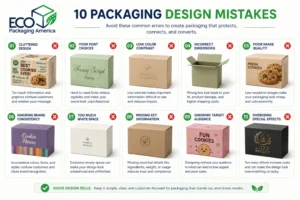
Here’s the simple truth: people remember boxes that look intentional. A clean logo, the right colors, and a finish that matches your brand — soft matte for an artisan sourdough shop, shiny gloss for a bold cupcake brand — does more for repeat business than another discount coupon ever will.
The research backs this up. A 2018 Ipsos survey for the Paper & Packaging Board found 72% of Americans say packaging design influences their purchase decisions, and that rises to 81% when they’re buying a gift — a huge share of bakery orders. Separately, a VistaPrint survey of 1,000 U.S. adults found 89% say packaging quality shapes how they perceive the product inside, and 64% have kept a piece of branded packaging after opening it. Your box keeps working long after the cake is gone.
Step 1: Get Your Logo Print-Ready
Before you even think about box size or finish, your logo file needs to be ready for print — not just for a website.
- Use a vector file (AI, EPS, or high-res PDF), not a JPEG pulled off your Instagram page. Blurry logos are the number-one reason first proofs get rejected.
- Keep it simple enough to read at 1 inch wide. If it’s too detailed, it turns into a smudge on a small box.
- Leave breathing room. A logo crammed into a corner looks like an afterthought.
- Have a one-color version ready. Single-color printing costs less, and foil and emboss both need a clean, solid shape to work from.
- Check the smallest box you sell. A logo that sings on a 10-inch cake box can disappear on a single-cupcake box, so test at your smallest size.
This step is why so many bakeries look for a custom bakery box design with logo that’s actually crisp in person, not just on a screen mockup.
If you don’t have a vector file yet
Plenty of small bakeries only have a PNG or a screenshot. That’s fixable: a designer can redraw the logo as a vector, usually quickly and inexpensively. It’s worth doing once, because that single file will serve every box size, sticker, and sign you ever print. Don’t let a printer scale up a low-resolution file and hope — that’s how soft, fuzzy edges end up on 2,000 boxes.
Step 2: Choose Brand Colors That Hold Up in Print
Screen colors and print colors are not the same. That bright pink that looks perfect on your phone can turn dull or muddy once it’s printed on kraft board.
A few rules that save headaches:
- Stick to 2–3 core brand colors. More than that, and the box looks cluttered.
- Ask for a physical swatch or proof before a full print run — not just a digital preview.
- Remember the board changes the color. White board shows colors true-to-screen; natural kraft gives everything a warmer, earthier tone.
- Know your color systems. Screens use RGB, printing uses CMYK, and spot colors (like Pantone) are matched inks. Bright neons and deep blues are the most common casualties of an RGB-to-CMYK conversion.
- Don’t rely on color alone. If your logo only reads because of a color contrast, it’ll struggle in one-color or foil printing.
Colors shifting between screen and print is one of the most common surprises for first-time orders — and it’s almost entirely preventable with one physical proof.
Step 3: Pick the Right Print Finish (Matte vs. Gloss vs. Foil)
This is where most bakery owners get stuck. Here’s the short version of each.
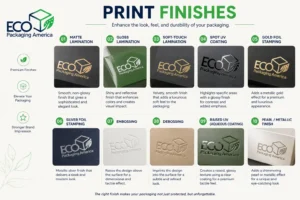
Matte finish
Soft, non-shiny look. Feels premium and natural. Great for organic, artisan, or rustic bakery brands. Fingerprints and smudges show less — which matters more than people expect for boxes handled by delivery drivers.
Gloss finish
Shiny, vibrant, eye-catching. Great for bold colors and bakeries with a fun, youthful brand. Colors pop more, but fingerprints show more too.
Foil stamping
Metallic gold, silver, or rose gold accents on your logo or text. Best for high-end bakeries, wedding cake boxes, or gift packaging. It costs more but creates a genuine luxury unboxing moment.
Finish comparison at a glance
| Finish | Look & feel | Hides handling marks | Relative cost | Best for |
| Matte | Soft, premium, natural | Best | Bold colors, youthful brands | |
| Foil accent | Metallic, luxury | Good (on accents) | $$$ | Wedding, gift, premium lines |
| Uncoated kraft | Raw, earthy, eco | Moderate | $ | Eco and farmers-market brands
|
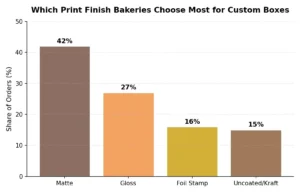
Bar chart showing matte as the most requested print finish for custom bakery boxes, followed by gloss, foil, and uncoated kraft
Chart 1: Print finishes most requested by our bakery clients, based on Eco Packaging America’s own order mix rather than an industry-wide survey. Matte leads because it photographs well and hides handling marks — a big deal for boxes traveling through delivery apps.
Step 4: Follow Simple Design Do’s and Don’ts
Do
- Keep your logo centered or in a consistent spot across every box size you order.
- Use food-safe, non-toxic ink — always confirm this with your printer.
- Test your design on the actual box shape, not just a flat mockup.
- Leave enough white space so the design can breathe.
- Keep important text well clear of fold lines and creases.
Don’t
- Don’t shrink your logo so much it becomes unreadable.
- Don’t use more than one accent font — it looks unplanned.
- Don’t skip a physical sample before a bulk print run.
- Don’t sacrifice box strength for a thinner, “prettier” board.
- Don’t put fine detail across a fold, where it will crack or misalign.
We put this list together after seeing the same handful of mistakes repeat, order after order.
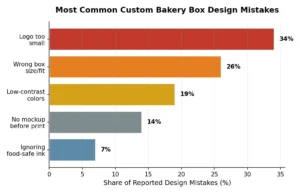
Horizontal bar chart of the most common bakery box design issues, led by logos too small to read and low-resolution logo files
Chart 2: The design issues we most often catch before a print run, based on our own proofing experience. Small logo sizing is still the single biggest one — which is exactly why the mockup step matters so much.
Step 5: Always Ask for a Mockup Before You Print
A custom bakery box mockup is a digital or physical sample showing exactly how your logo, colors, and finish will look on the real box — before you commit to hundreds or thousands of units.
Never skip this step. A mockup catches:
- Colors that look different in print than on screen
- Logos that are too small or placed awkwardly
- Text that gets cut off near box edges or fold lines
- Finishes that read differently on kraft than on white board
How to review a proof properly
- Check the logo at actual size, not zoomed in on a screen.
- Look at the proof in daylight — store lighting shifts how color reads.
- Fold a physical sample and check that nothing important lands on a crease.
- Confirm every piece of text: address, handle, website, allergen line.
- Approve in writing so there’s a clear record of the version going to print.
At Eco Packaging America, every custom order includes a free digital mockup and, on request, a physical sample — something a lot of budget print shops skip to save time. It’s a small step that prevents an expensive reprint.
Standard Sizes and What They’re Used For
| Box size | Best for |
| Single cupcake / mini box | Individual treats, party favors |
| 6-inch cake box | Small cakes, half-dozen cookies |
| 8–10 inch cake box | Standard birthday or layer cakes |
| Bakery tray box (long) | Baguettes, eclairs, pastry rows |
| Bulk / wholesale box | Cafes, grocery, catering orders |
Always measure height as well as width. Cake height is the dimension most often forgotten, and it’s the one that ruins a design when the lid presses on frosting.
What Custom Design Costs — and What It Returns
Custom printing costs more per box than a plain, unbranded one. The return shows up in three places:
- Free advertising. Every box carried down a street or photographed for social media is brand exposure you didn’t pay for again.
- Higher perceived value. Packaging design measurably influences buying decisions, especially on gift orders — which supports premium pricing.
- Repeat business. Packaging quality shapes how customers judge the product, and a box people keep is a brand they remember.
You don’t need foil on everything to capture most of this. A crisp logo, two well-chosen colors, and a matte finish get you most of the way. Save foil and specialty finishes for the premium and gift lines where customers already expect them.
Eco-Friendly Design Choices
Sustainable options don’t have to compromise the design:
- Recyclable kraft or FSC-certified board for a natural, earthy look.
- Soy-based or low-migration inks that keep the box recyclable and food-safe.
- Biodegradable window film where you want to show off the product.
- One-color printing on kraft, which uses less ink and looks deliberately artisan.
- Right-sized boxes, which cut material use and protect better than an oversized box.
Label what’s recyclable versus compostable accurately rather than adding a vague green claim. Transparency reads as more trustworthy than a generic leaf icon.
Seasonal and Limited-Run Designs
You don’t need a new box for every holiday. The cost-effective approach is to keep one core branded box and change the accents:
- Use printed sleeves, belly bands, or stickers for seasonal themes.
- Keep your logo placement identical year-round so brand recognition holds.
- Order seasonal accents early — holiday print queues fill up fast.
- Reserve a full seasonal box print for your highest-volume holiday only.
This gives you four fresh looks a year at roughly the cost of a label change.
Pros and Cons of Custom Bakery Box Design
| Pros | Cons |
| Builds instant brand recognition with every order | Costs more upfront than plain, unbranded boxes |
| Turns customers into free advertising when they share photos | Requires a design-ready logo file, which some bakers don’t have yet |
| Protects delicate baked goods better than generic boxes | Bulk orders need lead time — not ideal for last-minute needs |
| Adds a premium feel that supports higher pricing | Foil and specialty finishes raise the price per box |
| Works as a marketing tool, not just packaging | Design changes are impractical mid-run |
Expert Tips at a Glance
- Design for your smallest box first — if the logo works there, it works everywhere. 2. Ask for the proof on your actual board stock; kraft and white read completely differently. 3. Keep a one-color version of your logo on file for foil, emboss, and budget runs. 4. Photograph your finished box before ordering in bulk — if it doesn’t look good on camera, customers won’t share it. 5. Lock your artwork before scaling up; a finalized design is what makes bulk pricing safe.
Key Takeaways
- A vector logo, readable at 1 inch, is the foundation of every good box design.
- Screen colors shift in print — confirm with a physical proof on your actual board.
- Match the finish to your brand: matte for artisan, gloss for bold, foil for premium.
- Keep text clear of fold lines and leave white space so the design breathes.
- Never skip the mockup; it’s the cheapest insurance against a costly reprint.
- Seasonal sleeves beat seasonal reprints for cost and brand consistency.
Where Eco Packaging America Fits In
A lot of packaging suppliers can print a logo on a box. Very few combine that with eco-friendly materials, food-safe inks, fast turnaround, and a free mockup on every order — without charging premium prices for it. That combination is where Eco Packaging America stands apart: recyclable, sturdy bakery boxes that hold their shape, hold your brand, and hold up in the real world, from delivery apps to wedding tables.
Frequently Asked Questions
What is the best material for custom bakery boxes? Kraft board and SBS (solid bleached sulfate) board are the two most common choices. Kraft gives a rustic, eco-friendly look and warms up printed colors, which suits artisan and farmers-market brands. SBS gives a clean white base that keeps bright colors true to screen, making it better for bold, colorful designs. Both can be food-safe when paired with the right inks and coatings. Choose based on the look you want and confirm food-grade documentation with your supplier before ordering.
How much does a custom bakery box with a logo cost? It depends on box size, print finish, and order quantity. Setup costs like printing plates and die-cutting are fixed, so they spread across more units as your order grows, which means bulk orders always lower the per-box cost significantly. Foil stamping, embossing, and specialty coatings add to the price. The most reliable way to plan is to request quotes at two different quantities so you can see how much the per-unit price drops before committing.
Can I get a custom bakery box design with my logo in small quantities? Yes. Many packaging partners, including Eco Packaging America, offer smaller minimum order quantities for new or small bakeries. Small runs cost more per box because setup is spread over fewer units, but they let you confirm fit, color, and finish before committing to a larger order. This is usually the smartest path for a new bakery: prove the design works in the real world first, then scale up to a bulk run once your branding and box sizes are locked in.
What’s the difference between matte and gloss finish for bakery boxes? Matte has a soft, non-shiny surface that feels premium and natural, and it hides fingerprints and handling marks well — useful for boxes traveling through delivery apps. Gloss is shiny and vibrant, making colors pop, which suits bold and youthful brands, but it shows smudges much more easily. Neither is objectively better. Pick the one that matches your brand personality, and if you’re unsure, ask for both on a proof and compare them in daylight.
Do I need a special file type for my logo? Yes. A vector file (AI, EPS, or high-resolution PDF) prints far more clearly than a standard JPEG or PNG, because vectors scale to any size without losing sharpness. Raster files pulled from a website or social media almost always look soft or pixelated in print. If you only have a PNG, a designer can redraw it as a vector fairly quickly, and that single file will then serve every box size, sticker, and sign you print from then on.
How long does it take to get custom bakery boxes printed? Typical turnaround is around one to three weeks depending on order size and finish, though rush options are often available. First-time custom runs take longer than reorders because they include proofing, sampling, and setup. Specialty finishes like foil add time as well. Ask your supplier for both the first-run and reorder lead times in writing, and order ahead of holiday peaks when production queues fill up, so you’re not paying rush fees.
Are custom bakery boxes food safe? Only if the boxes use food-safe, non-toxic inks and coatings, so always confirm this with your supplier before ordering. Anything that touches the product directly should be food-grade, and printing should use food-safe, low-migration inks. Reputable suppliers can provide documentation on request. Don’t assume a box is food-safe just because it’s sold as bakery packaging — asking for the paperwork takes a moment and protects both your customers and your business.
What size bakery box do I need for a standard cake? Most standard cakes fit an 8 to 10 inch box, but width alone isn’t enough. Always measure your cake’s height too, including any topper or tall frosting, because height is the dimension bakers most often forget and the one that ruins a design when the lid presses down. If you sell several cake sizes, standardize on two or three box sizes that cover them, and check each one with a real cake before placing a bulk order.
Can I see a mockup before printing my full order? Yes, and you should always ask for one. A mockup shows how your logo, colors, and finish will actually look on the real box before you commit to hundreds or thousands of units. Review it at actual size in daylight, fold a physical sample to check nothing important lands on a crease, and confirm every piece of text. Approving a proof in writing creates a clear record of exactly which version went to print, which protects you if anything looks off later.
Is foil stamping worth it for a small bakery? It can be, if you sell premium items like wedding cakes or gift boxes, where foil boosts perceived value and helps justify higher prices. For everyday retail boxes it’s often an unnecessary cost. A practical approach is to keep a clean matte box for standard orders and reserve foil for a premium or gift line. Foil also needs a simple, solid logo shape to stamp well, so check that your logo has a one-color version before budgeting for it.
What eco-friendly options are available for bakery packaging? Recyclable kraft board, FSC-certified paperboard, soy-based or low-migration inks, and biodegradable window film are all common choices. One-color printing on kraft uses less ink and reads as deliberately artisan, and right-sizing your boxes cuts material use while protecting the product better than an oversized box. Whichever you choose, label what’s recyclable versus compostable accurately rather than adding a vague green claim — specific, honest labeling builds more trust than a generic leaf icon.
How do I make sure my box design matches my brand? Stick to your two or three core brand colors, use your actual vector logo file rather than a screenshot, and keep logo placement consistent across every box size you order. Request a physical or digital proof on your actual board stock, since kraft and white change how colors read. It also helps to view the box next to your other brand touchpoints — your sign, bags, and stickers — so everything reads as one identity rather than separate designs.
Final Thoughts
A great custom bakery box design isn’t about cramming in every color and finish available. It’s about a crisp logo, a small and consistent color palette, a finish that matches your brand, and a layout that respects the physical box — its folds, its size, and how it gets handled. Get those basics right and the box does double duty: protecting your baking and marketing your bakery every time someone carries it out the door.
Before you place a bulk order, get a mockup, check your logo at actual size, and look at a proof on your real board stock. That one round of review is what separates boxes you’re proud of from boxes you reprint.
Ready to design your box? Eco Packaging America produces custom bakery boxes with food-safe inks, recyclable kraft and FSC options, matte, gloss, and foil finishes — plus a free digital mockup on every custom order and physical samples on request. Send us your logo, box sizes, and brand colors, and we’ll show you exactly how it will look before you print. Get a free mockup and quote today.
About the Author
Eco Packaging America — Packaging Team. Custom Eco-Friendly Packaging Specialists for US Markets. With over 5 years of experience producing custom eco-friendly packaging for US food brands, bakeries, and e-commerce businesses, we’ve helped 200+ American brands create packaging that protects product and sells. We specialize in sustainable kraft, rigid, and mailer box solutions with low minimum orders and fast turnaround.