Picture Black Friday morning. Orders are pouring in, notifications won’t stop, and then someone opens the storeroom and says it: we’re almost out of boxes.
Running out costs you the busiest sales days of the year. Over-ordering ties up cash and storage space in boxes you may not use until next November. Both problems have the same fix: a simple forecast, done before you order.
This guide shows you how to work out how many boxes you need for Black Friday, step by step, with worked examples for small online businesses, brands, bakeries, and wholesalers.
Quick Answer
Boxes to order = expected orders × boxes per order × (1 + safety buffer). Start from last year’s Black Friday to Cyber Monday orders, adjust for this year’s growth and promotions, count how many boxes a typical order uses, and add a buffer for damaged boxes, replacements, and surprise demand. For example: 500 expected orders × 1.2 boxes per order × 1.15 buffer = 690, rounded up to 700. For 2026, approve your artwork by 30 October to have boxes before Black Friday.
Why a Forecast Matters
Black Friday is followed by Small Business Saturday and Cyber Monday, so most brands face four or five days of peak demand in a row, straight into the Christmas shipping season. Packaging is the one input you can’t buy more of halfway through the weekend: custom boxes take approximately 12–15 business days from artwork approval, so a mid-weekend shortage can’t be fixed with a quick reorder.
A forecast doesn’t need to be perfect. It needs to be close enough that you don’t run out, and honest enough that you don’t over-order.
The Formula, Step by Step
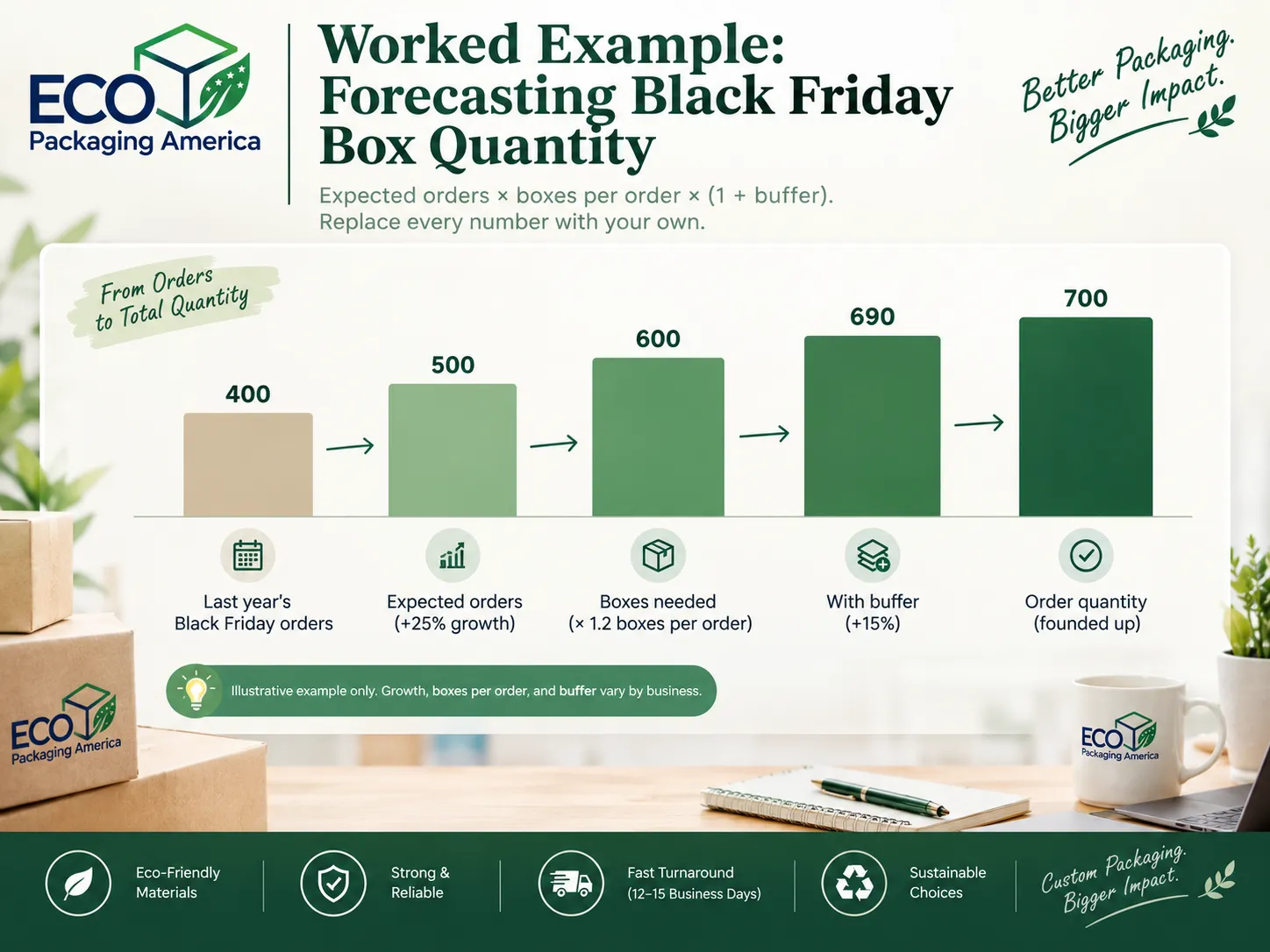
Worked example of a Black Friday box forecast: 400 last-year orders become 500 expected orders with 25 percent growth, 600 boxes at 1.2 boxes per order, 690 with a 15 percent buffer, and an order quantity of 700 after rounding up
Chart 1: A worked forecast. Replace every number with your own.
Step 1: Start with last year. Count how many orders you shipped from Black Friday to Cyber Monday last year. If this is your first Black Friday, use your busiest recent week and scale it by how big you expect your promotion to be.
Step 2: Adjust for this year. Has your email list grown? Are you running more ads, launching new products, or offering a bigger discount? Adjust your expected orders up or down. Be honest: an optimistic forecast is how brands end up with a storeroom of unused boxes.
Step 3: Count boxes per order. Most orders use one box. Bundles, gift sets, and multi-item orders may use two. Bakeries often use a pie box plus a smaller cookie box. Your average across all orders might be 1.0, 1.2, or 2.0.
Step 4: Add a safety buffer. The buffer covers boxes damaged in packing, replacement shipments, and demand you didn’t predict. Choose it based on how uncertain your forecast is: a business with steady repeat customers can use a smaller buffer than a first-time Black Friday seller. The examples in this guide use 15–20%.
Step 5: Round up and check the timeline. Round up to a practical order quantity and confirm the boxes will arrive in time.
How Many Boxes by Business Type
The formula is the same for everyone. What changes is what you count.
Small Online Business
If you sell through Shopify, Etsy, or your own site, your orders are smaller but your cash is tighter, so every box counts.
- Count: last year’s Black Friday to Cyber Monday orders, or your best recent week scaled for your promotion.
- Keep sizes to two or three. Fewer sizes are simpler to pack and easier to forecast.
- Example: 300 expected orders × 1 box × 1.20 = 360 boxes.
Online Brand
Brands running ads, email campaigns, and influencer posts can usually forecast from campaign plans.
- Count: expected orders from your email list, ad budget, and planned launches.
- Allow for bundles, which often need a larger box.
- Use one main design across all sizes, with the Black Friday message on an insert card so leftover boxes work for Christmas.
- Example: 2,500 expected orders × 1 box × 1.20 = 3,000 boxes.
Bakery
Bakeries work differently: products are fresh, boxes must be food-safe, and pre-orders do much of the forecasting for you.
- Count: confirmed pre-orders plus expected walk-in sales.
- Count boxes per order carefully. A pie plus cookies may be two boxes.
- Example: 400 orders × 2 boxes × 1.20 = 960 boxes.
Our Thanksgiving packaging deadlines guide explains how to set your pre-order limit to match your box quantity.
Wholesaler
Wholesale demand arrives before Black Friday, as retailers stock up in October and early November.
- Count: confirmed purchase orders, plus your regular buyers’ usual reorders.
- Plan by SKU, then convert to cartons and pallets.
- Example: 5,000 boxes of demand × 1.15 = 5,750 boxes.
Summary Table
| Business | Example orders | Boxes per order | Buffer | Order quantity |
| Small online business | 300 | 1 | 20% | About 360 |
| Online brand | 2,500 | 1 | 20% | About 3,000 |
| Bakery | 400 | 2 | 20% | About 960 |
| Wholesaler | 5,000 boxes of demand | — | 15% | About 5,750 |
Sample forecasts to show the method. Use your own sales data.
Plan by Size, Not Just by Total
A single total is only half the forecast. If you use three box sizes, forecast each one. Running out of your most popular size is just as bad as running out of boxes altogether.
- Group products by the box they ship in, then forecast each group.
- Look at last year’s split between sizes. Many brands find one size carries most orders.
- Consider consolidating sizes. Using one size for several products makes forecasting easier and helps your per-box price.
Our Black Friday mailer boxes guide covers how to size mailers closely to your products.
Should You Order for Black Friday Only, or the Whole Season?
If your box design isn’t tied to the date, one order can cover Black Friday, Cyber Monday, and Christmas. That changes the forecast:
| Approach | Forecast covers | Best when |
| Black Friday only | Black Friday to Cyber Monday | The design is Black Friday-specific, or storage is tight |
| Whole holiday season | Black Friday through Christmas | The design is season-neutral and you have storage |
A whole-season order is usually simpler than reordering in December, and per-box price falls as quantity rises. The trade-off is storage space and cash committed up front.
What If You Run Out?
Custom boxes take approximately 12–15 business days from artwork approval to delivery, so a reorder placed during Black Friday weekend won’t arrive until mid-December. Plan for it in advance:
- Set a reorder point. Decide now how many boxes left will trigger a reorder for the Christmas season.
- Reorders are faster to start. Approved artwork can go straight to production without a new design or proof.
- Keep a small backup of plain boxes with branded stickers or tape for the final days if you misjudge.
Minimum Order and Pricing
Our minimum order is 100 boxes, with no die or plate charges, so even a small forecast is practical. Per-box price falls as quantity rises, so ask for quotes at your forecast quantity and one step above it. Sometimes the extra boxes cost relatively little and cover Christmas orders. Our seasonal packaging MOQ guide explains how quantity tiers work.
Timing for Black Friday 2026
Black Friday is Friday 27 November. To have boxes around 20 November, a week before the sale, approve your artwork by 30 October. After that, standard production lands in Thanksgiving week. Our Black Friday packaging deadlines guide covers every cut-off and the plan B options.
Common Forecasting Mistakes
- Forecasting total boxes but not each size, then running out of the popular one.
- Forgetting multi-box orders such as bundles and gift sets.
- Using an optimistic sales target instead of a realistic forecast.
- Skipping the buffer, so a few damaged boxes cause a shortage.
- Printing the date on the box, so leftovers can’t be used for Christmas.
- Forecasting after the approval deadline, which leaves no time to order.
Pros and Cons of Forecasting Early
| Pros | Cons |
| You won’t run out on the busiest days | You must estimate demand before the season starts |
| More choice of styles, sizes, and finishes | Extra boxes need storage space |
| Time to check proofs properly | Cash is committed earlier |
| Easier to plan one order for the whole season | Forecasts can change if campaigns change |
A sensible buffer and a season-neutral design solve most of the cons. A few extra boxes cost far less than lost sales.
How We Help
- Help with your quantity. Share last year’s numbers and your product mix, and we’ll help you work out the order.
- Quotes within 24 hours at several quantities, so you can compare price breaks.
- A 100-box minimum, with no die or plate charges.
- Production and delivery in approximately 12–15 business days, with free shipping to all 50 states.
- Reorders from approved artwork, without starting the design again.
Not sure how many boxes to order? Send last year’s Black Friday order count, your product sizes, and this year’s plans. We’ll help you work out the quantity and quote it within 24 hours. Request a quote · sales@ecopackagingamerica.com
Frequently Asked Questions
How many boxes do I need for Black Friday?
Multiply your expected orders by the average number of boxes per order, then add a safety buffer: expected orders × boxes per order × (1 + buffer). For example, 500 expected orders × 1.2 boxes per order × 1.15 = 690, rounded up to 700. Base expected orders on last year’s Black Friday to Cyber Monday sales, adjusted for this year’s growth and promotions.
How big should my safety buffer be?
It depends on how uncertain your forecast is. A business with steady repeat customers and good data can use a smaller buffer; a first-time Black Friday seller or one launching a big new campaign should use a larger one. The buffer also covers boxes damaged during packing and replacement shipments. The examples in this guide use 15–20%.
What if I have no sales data from last year?
Use your busiest recent week as a starting point and scale it by the size of your planned promotion, email list, and ad spend. Be conservative with growth assumptions, then add a larger buffer than an established business would. If you’re unsure, a season-neutral design lets any surplus carry on to Christmas orders.
How do I count boxes per order?
Look at what a typical order contains. Single-product orders use one box. Bundles, gift sets, and multi-item orders may need a larger box or two boxes. Bakeries often use two boxes per order, such as a pie box and a cookie box. Average it across all expected orders to get your boxes-per-order figure.
Should I forecast each box size separately?
Yes. A total forecast can hide a shortage of your most popular size. Group products by the box they ship in, forecast each group, and check last year’s split between sizes. Reducing the number of sizes you use makes forecasting easier and usually improves your per-box price.
Should I order for Black Friday only or the whole holiday season?
If your design isn’t tied to the date, ordering for Black Friday through Christmas in one run is usually simpler and better value per box than reordering in December. Order for Black Friday only if your design is sale-specific or storage space is limited. Put the Black Friday message on an insert card or sticker to keep the box usable after the sale.
Can I reorder boxes during Black Friday week?
You can, but custom boxes take approximately 12–15 business days from artwork approval, so a reorder placed during Black Friday weekend arrives around mid-December. That’s useful for Christmas, not for the sale itself. Set a reorder point in advance, and keep a small backup of plain boxes with branded stickers for the final days if needed.
When should I order boxes for Black Friday 2026?
Approve your artwork by 30 October 2026 to have boxes around 20 November, a week before Black Friday on 27 November. Production and delivery take approximately 12–15 business days from approval, with shipping included. Finish your forecast before that date so the quantity is settled when you approve.
What is the minimum order for custom boxes?
Our minimum is 100 boxes, with no die or plate charges, so a small forecast is still practical for custom printing. Per-box price falls as quantity rises, so it’s worth requesting quotes at your forecast quantity and one step above to see where the price breaks fall.
How do bakeries forecast boxes for Black Friday and Thanksgiving?
Start with confirmed pre-orders, add expected walk-in sales, and multiply by the number of boxes per order, since a pie and cookies may be two boxes. Add a buffer for damaged boxes and late additions. Because pre-orders cap what you can sell, set your pre-order limit and your box quantity together.
How do wholesalers forecast packaging for Black Friday?
Wholesale demand comes earlier, as retailers stock up in October and early November. Count confirmed purchase orders, add your regular buyers’ usual reorders, and plan by SKU before converting to cartons and pallets. Add a buffer, because one missing carton can hold up a whole customer delivery.
What should I do with leftover boxes?
If the design isn’t dated, use them for Cyber Monday follow-ups, Christmas orders, and January sales. That’s the main reason to keep the year and “Black Friday” wording off the box itself. Store leftover boxes flat in a dry place, and factor the surplus into next season’s forecast.
Final Thoughts
Working out how many boxes you need for Black Friday comes down to one formula: expected orders, times boxes per order, plus a buffer. Use last year’s numbers, be realistic about growth, forecast each size, and decide whether one order should cover the whole season.
For 2026, finish the forecast and approve your artwork by 30 October. Send us your numbers and we’ll help you land on the right quantity.
About the Author
Eco Packaging America — Packaging Team. Custom Eco-Friendly Packaging Specialists for US Markets. We produce custom packaging for US food brands, bakeries, confectioners, chocolatiers, candle makers, and e-commerce businesses, specialising in sustainable kraft, rigid, and mailer box solutions with free design support and fast turnaround.