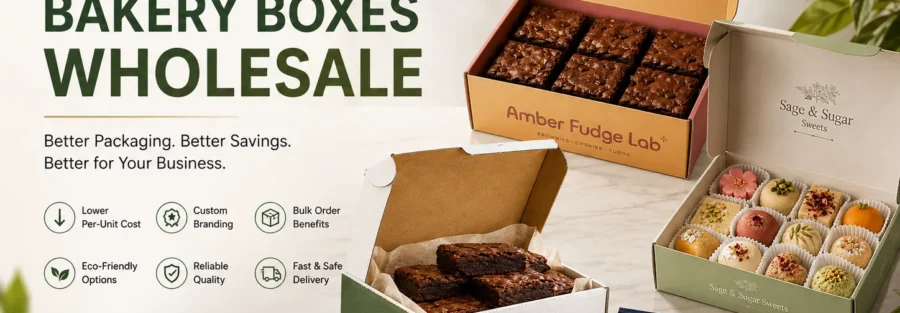
If your bakery is outgrowing small retail packaging runs, chances are you’ve already typed custom bakery boxes wholesale into Google looking for a straight answer: how much can you actually save, what’s a realistic minimum order quantity (MOQ), and when does switching to bulk sourcing make sense? This guide walks through all of it — real cost comparisons, a breakdown of MOQ tiers, a simple break-even calculation, and the honest pros and cons of moving away from small retail orders.
In This Guide
- What “bakery boxes wholesale” actually means
- The benefits of buying in bulk
- Understanding MOQ tiers
- A realistic cost-savings example
- How to calculate your break-even MOQ
- Hidden costs and mistakes to avoid
- When to switch to wholesale
- Pros and cons
- How to choose a wholesale supplier
- Eco-friendly options at scale
- Expert tips, do’s and don’ts, and FAQs
Quick Answer
Buying bakery boxes wholesale means ordering custom packaging in bulk, direct from a manufacturer, so fixed setup costs spread across more units and your cost per box drops. Most custom MOQs sit between 500 and 1,000 boxes, with trial runs as low as 100–250. The switch pays off once your monthly box count is stable, your branding is locked in, and you have the storage and cash flow to buy ahead.
What Does “Bakery Boxes Wholesale” Actually Mean?
Buying wholesale bakery boxes simply means ordering your custom packaging directly from a manufacturer or packaging supplier in bulk, rather than buying smaller batches from a retail packaging shop or a local print vendor. Wholesale suppliers price per unit based on volume — the more boxes you order in a single run, the lower your cost per box, because setup costs like die-cutting, plate printing, and material tooling get spread across a larger batch.
For bakeries that go through hundreds or thousands of boxes a month — cupcake boxes, macaron boxes, cake boxes, or pastry boxes — this pricing model changes everything about how packaging fits into the cost of running the business.
It helps to remember how big and standardized this supply chain already is. According to the Fibre Box Association, U.S. mills shipped about 381 billion square feet of corrugated in 2024, worth roughly $40.8 billion — a mature, high-volume industry, which is exactly why per-unit pricing rewards scale.
Benefits of Buying Bakery Boxes in Bulk
Ordering custom bakery boxes wholesale isn’t just about saving a few cents per unit. Here’s what bulk buying actually changes for a working bakery:
- Lower per-unit cost. Setup and printing costs are fixed regardless of order size, so spreading them across more units brings the price per box down significantly.
- Consistent branding. One large print run means every box — from your grand-opening month to six months later — matches in color, logo placement, and finish.
- Fewer reorders, less downtime. Running out of boxes mid-week is a real operational risk. Bulk stock removes that pressure.
- Better negotiating position. Suppliers will often customize inserts, add finishes (matte, gloss, foil), or adjust box depth for bulk clients in ways they won’t for small trial orders.
- Lower shipping cost per unit. Freight per box drops sharply when it’s spread across a full pallet instead of a handful of small parcels.
- A hedge against price swings. Input costs move. Industry analyses flagged sharp kraft and recycled-fiber price swings through 2024 that fed straight into box prices; locking in a bulk run can shelter you from part of that volatility.
Understanding MOQ for Custom Bakery Boxes
MOQ — minimum order quantity — is the smallest batch a supplier will produce for a given box design. It’s the real question behind searches like “minimum order quantity bakery boxes” and “custom bakery boxes wholesale for small business”: how much do I have to commit to before this makes financial sense?
Typical MOQ tiers in custom packaging generally fall into these ranges:
| Order tier | Typical quantity | Best suited for |
| Trial / small batch | 100 – 250 boxes | New bakeries testing a design |
| Standard wholesale | 500 – 1,000 boxes | Established bakeries with steady weekly output |
| Bulk wholesale | 5,000 – 10,000 boxes | High-volume bakeries, chains, subscription boxes |
| Enterprise bulk | 10,000+ boxes | Multi-location bakeries, private-label brands |
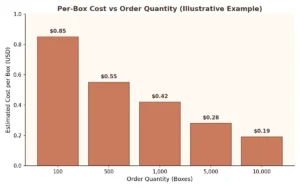
As the chart shows, the cost curve flattens as volume increases. That’s the core economic reason wholesale sourcing becomes attractive once a bakery has predictable, repeat demand — the first few hundred boxes carry most of the setup cost, and everything after that is mostly material.
Cost Savings: A Realistic Example
Take a mid-size bakery producing around 2,000 boxes a month for cakes, cupcakes, and pastry orders. Sourcing those retail — in smaller batches, from a local print shop, without volume pricing — typically costs noticeably more per unit than locking in a single wholesale run.
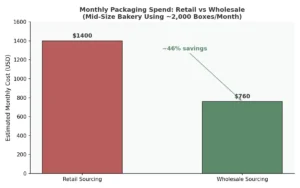
Bar chart comparing illustrative monthly packaging spend for retail versus wholesale sourcing
Chart 2: Illustrative monthly packaging spend, retail vs. wholesale, for a bakery using about 2,000 boxes a month. Replace with your own quotes before you decide.
That kind of gap, month after month, adds up to a meaningful chunk of annual overhead — money that can instead go toward ingredients, staffing, or expanding the menu. The point isn’t the exact dollar figure, which depends on your box and supplier; it’s the shape of the gap, and how quickly it repays the larger upfront order.
How to Calculate Your Break-Even MOQ
You don’t have to guess whether wholesale is worth it. Run these numbers before you commit:
- Average your real volume. Pull your last three months of packaging invoices and calculate your average monthly box count.
- Get two quotes. Ask for a per-unit price at your current small-batch volume and at the next wholesale tier.
- Compare monthly spend. Multiply each per-unit price by your monthly volume to see the monthly difference.
- Add the wholesale-only costs. Include upfront capital, inbound freight, and any storage you’ll need to rent.
- Find your payback period. Divide the extra upfront cost by your projected monthly savings to see how many months it takes to break even.
- Decide against your demand. If payback lands inside your comfort window and demand is stable, commit to that tier. If demand is still bouncing around, stay flexible.
This five-minute exercise turns “wholesale feels cheaper” into a number you can actually defend to yourself or a business partner.
Hidden Costs and Mistakes to Avoid
Bulk sourcing saves money — but only if you sidestep the traps that quietly eat the savings:
- Dead stock from switching too early. Order 10,000 boxes before your volume is stable and you may be storing packaging for a year.
- Design lock-in. Large runs aren’t practical to change mid-batch, so a rushed logo or wrong box depth gets multiplied by thousands.
- Storage you didn’t budget for. Boxes ship flat but still fill a backroom or a rented pallet space. Factor that cost in.
- Freight surprises. A pallet is cheaper per box but has its own shipping and handling cost — get it quoted, don’t assume.
- Skipping the sample. Approve a physical sample before the full run. Fixing a fit or print issue on 5,000 boxes is far more expensive than catching it on one.
- Rush-fee creep. If you cut it close and reorder in a panic, rush production and expedited freight can erase a whole tier’s savings.
When Should a Bakery Switch to Wholesale Packaging?
Not every bakery is ready for bulk bakery boxes on day one, and that’s fine. A few signals it’s time:
- You’re reordering more than once a month. Frequent small reorders usually mean you’re paying the small-batch premium repeatedly.
- Your monthly box usage has stabilized. Wholesale works best when you can commit to a predictable number — seasonal spikes aside.
- You’ve locked in your branding. Bulk orders assume the design (logo, size, color) is finalized.
- You have storage space. Wholesale boxes ship flat but still take up room — plan for it before a 10,000-unit order.
- Cash flow allows the upfront investment. Bulk means paying more now for a lower cost per unit later.
Pros and Cons of Wholesale Bakery Boxes
| Pros | Cons |
| Significantly lower cost per box at scale | Higher upfront capital required |
| Consistent branding across every order | Less flexibility to change design quickly |
| Fewer stockouts and reorder cycles | Requires storage space for bulk inventory |
| Better access to premium finishes and custom inserts | MOQ may exceed what a small bakery needs today |
| Lower shipping cost per unit | Risk of overstocking if demand shifts |
| Stronger supplier relationship and priority production | Longer lead time on the initial bulk run |
How to Choose a Wholesale Packaging Supplier
Not every supplier that can print a box can protect a cake. When you’re comparing wholesale partners, vet these:
- Baked-goods experience. Snug-fit engineering and correct box depth matter more for fragile product than generic box printing.
- Food-grade materials and inks. Anything touching the product should be food-safe; ask for documentation.
- Sample-first process. A supplier confident in fit will send a physical sample before the full run.
- Print registration and finish consistency. Foil, matte, and gloss should match across an entire batch, not just the first carton.
- Realistic lead times. Get the initial-run and reorder lead times in writing so you can time orders around demand.
- Eco options. If sustainability is part of your brand, confirm recyclable, kraft, and FSC-certified choices are available at your volume.
Eco-Friendly Options at Scale
Sustainability doesn’t have to disappear when you buy in bulk. Recyclable kraft, FSC-certified paperboard, and recycled-content corrugated are all available at wholesale volumes, and demand for them keeps rising alongside e-commerce — which now accounts for roughly a sixth of U.S. retail sales, per the U.S. Department of Commerce. Buying eco materials in a single large run also means consistent recyclability messaging on every box. Lead with recyclable, right-sized packaging and food-safe inks; it’s the most credible way to put a green claim on the box without overstating it.
A Note From Experience
Bakeries that switch to wholesale packaging too early — before volume is consistent — often end up with excess stock sitting in storage for months. On the flip side, bakeries that wait too long keep bleeding money on small-batch pricing without realizing how much it’s costing over a year. The right move is almost always tied to your actual monthly box count, not a guess. Pull your last three months of packaging invoices, average the volume, and compare it against the MOQ tiers above before signing a bulk order.
Why Bakeries Trust Eco Packaging America for Wholesale Orders
Not every packaging supplier can handle bulk custom orders without compromising on fit, print quality, or turnaround — and that’s exactly where Eco Packaging America stands apart. Years of hands-on experience producing custom bakery packaging at scale means every wholesale run, whether it’s 500 boxes or 50,000, goes through the same precision die-cutting, snug-fit engineering, and quality checks that keep boxes from crushing, shifting, or arriving damaged.
From dialing in the exact depth for cupcake and macaron boxes to matching foil, matte, or gloss finishes consistently across an entire batch, this is detail-level craftsmanship that’s hard to find elsewhere. Bakeries that switch typically notice the difference right away: tighter fit, sturdier structure, cleaner print registration, and packaging that actually protects the product it holds — not just boxes that look good in a catalog photo.
For a bakery weighing whether to move to bulk sourcing, working with a supplier that genuinely understands baked-goods packaging — not just generic box manufacturing — is the difference between wholesale that saves money and protects your product, and wholesale that only does the former.
Expert Tips at a Glance
- Base the decision on your averaged three-month box count, not your busiest week. 2. Always approve a physical sample before a bulk run — fit and print errors multiply at scale. 3. Order slightly behind, not ahead of, an unproven seasonal spike to avoid dead stock. 4. Ask for both first-run and reorder lead times in writing so you never reorder in a panic. 5. Lock your artwork before you scale — a finalized design is what makes bulk pricing safe.
Do’s and Don’ts
Do
- Do average your real monthly volume before choosing a tier.
- Do get quotes at two volumes and calculate your payback period.
- Do request a sample and confirm food-grade materials.
- Do budget for freight and storage, not just the per-box price.
Don’t
- Don’t commit to enterprise volume before demand is stable.
- Don’t change artwork mid-run — finalize it first.
- Don’t ignore lead times and get forced into rush fees.
- Don’t chase the lowest price at the cost of fit and protection.
Key Takeaways
- Wholesale means bulk, direct-from-manufacturer pricing where setup costs spread across more units.
- Most custom MOQs sit at 500–1,000 boxes; trial runs can start at 100–250.
- The cost curve flattens fast — the biggest per-box savings come early, then level off.
- Switch when volume is stable, branding is locked, and cash flow and storage allow.
- Calculate your break-even payback period before committing; don’t rely on a gut feeling.
- Choose a supplier that understands baked-goods fit and protection, not just printing.
Frequently Asked Questions
What is a typical MOQ for custom bakery boxes wholesale? Most suppliers set MOQs between 500 and 1,000 units for custom-printed designs, though many offer trial runs as low as 100–250 boxes so you can test a design first. The exact minimum depends on the box style, print complexity, and material. If a 500-box minimum feels high, ask about a smaller trial run at a slightly higher per-unit price — it lets you confirm fit, color, and quality before committing to a larger, cheaper bulk order down the line.
Are wholesale bakery boxes cheaper than retail packaging? Yes. Per-unit cost drops as order volume rises, because fixed setup costs like printing plates and die-cutting are spread across more units. The savings are largest in the first jump from small-batch to standard wholesale, then level off at higher volumes. The catch is upfront cost: you pay more at once for a lower price per box. Run a quick payback calculation — extra upfront cost divided by monthly savings — to see how fast a bulk order pays for itself at your volume.
Can I customize inserts on a wholesale order? Usually yes, and often more freely than on small orders. At wholesale volumes, suppliers are typically more willing to add insert trays, foam padding, dividers, and custom depths, because the setup cost is spread across a larger run. Inserts matter most for fragile items like cupcakes and macarons, where a snug fit prevents shifting and damage. Confirm insert options and any added tooling cost up front, and approve a sample with your actual product inside before the full run.
How much can a bakery actually save by buying boxes wholesale? It depends on your box, volume, and supplier, so treat any single figure as a starting point rather than a promise. The savings come from spreading fixed setup costs across more units and from lower per-box freight on a pallet. The most reliable way to know your number is to get per-unit quotes at your current volume and at the next tier, multiply each by your monthly box count, and compare. Then subtract wholesale-only costs like storage and freight to see the true monthly difference.
How much storage space do wholesale bakery boxes need? Bakery boxes ship and store flat, so they take less room than assembled boxes, but a bulk run still needs real space. A few thousand flat boxes can fill several cartons or a pallet, and enterprise volumes may need rented storage. Before committing to a large tier, measure your available backroom or warehouse space and ask the supplier for the pallet dimensions and count. Factoring storage into your cost comparison keeps a “cheaper” bulk order from quietly costing more than it saves.
What’s the lead time on a bulk bakery box order? Initial custom runs take longer than reorders because they include design proofing, sampling, and setup. Reorders of an approved design are usually faster. Lead time also varies with print complexity, finishes like foil, and the supplier’s current queue. Always get both the first-run and reorder lead times in writing, then plan orders around your demand — especially before holiday peaks, when production queues fill up. Ordering early is the simplest way to avoid rush fees and expedited freight that can erase your bulk savings.
Can a small or new bakery buy wholesale, or is the minimum too high? New bakeries can absolutely start, usually with a trial run of 100–250 boxes. That lets you confirm fit, color, and quality at a modest commitment before scaling to a cheaper, larger tier. The real question isn’t your size — it’s whether your monthly volume and branding are stable enough to justify buying ahead. If you’re still testing box sizes or your logo, stay with smaller runs a little longer. Once demand steadies and the design is locked, stepping up to standard wholesale is where the savings begin.
Do wholesale bakery boxes come in eco-friendly materials? Yes. Recyclable kraft, FSC-certified paperboard, and recycled-content corrugated are all available at wholesale volumes, and buying eco materials in one large run keeps your recyclability messaging consistent across every box. Ask your supplier to confirm which materials and food-safe inks are offered at your order size. If sustainability is part of your brand, lead with recyclable, right-sized packaging rather than the most expensive specialty material — it’s the most credible, cost-effective way to back up a green claim on the box.
What finishes can I get on wholesale bakery boxes? Common options include matte and gloss lamination, spot UV, foil stamping, and embossing, along with window cutouts for bakery boxes that show off the product. Finishes are often easier to justify at wholesale volume because setup cost spreads across more units. The key is consistency: foil and color should match across the entire batch, not just the first carton, so ask to see a production sample. Keep everything that touches food food-grade, and use finishes to reinforce your brand rather than to chase a trend.
How do I avoid overordering when I switch to wholesale? Base your order on your averaged three-month box count, not your single busiest week, and lean slightly conservative on any unproven seasonal spike. Start at the tier that matches steady demand rather than your most optimistic forecast, and confirm reorder lead times so you can restock without panic. Keeping your artwork locked means reorders are quick and identical. Overordering usually comes from buying ahead of demand you haven’t confirmed yet — let stable, repeat volume, not hope, set the quantity.
Final Thoughts
Switching to custom bakery boxes wholesale is less about chasing the lowest price and more about matching your packaging strategy to your actual production volume. Once your bakery has predictable monthly demand, locked-in branding, and the storage to match, bulk sourcing turns packaging from a recurring expense into a smart, fixed-cost investment. Run the break-even math, order a sample, and step up one tier at a time — that’s how the savings show up without the dead stock.
Ready to price a wholesale run? Eco Packaging America produces custom bakery boxes at every scale — from 500-box trial runs to 50,000-box enterprise orders — with snug-fit engineering, food-grade materials, kraft and FSC eco options, and consistent finishes across the whole batch. Tell us your box style, monthly volume, and branding, and we’ll recommend the right MOQ tier and send a quote. Request your free wholesale bakery packaging quote today.
About the Author
Eco Packaging America — Packaging Team. Custom Eco-Friendly Packaging Specialists for US Markets. With over 5 years of experience producing custom eco-friendly packaging for US food brands, bakeries, and e-commerce businesses, we’ve helped 200+ American brands create packaging that protects product and sells. We specialize in sustainable kraft, rigid, and mailer box solutions with low minimum orders and fast turnaround.