If you run a bakery, café, or food business, the rules about what you can hand a customer are changing state by state — and sometimes city by city. There is no single federal law banning single-use plastic in America. Instead, each state writes its own rules, and that patchwork is exactly what makes packaging laws by state so confusing for small business owners trying to stay compliant in 2026.
At Eco Packaging America, compliance research is part of our daily job. Our packaging team tracks state-by-state plastic laws so our bakery and food-service clients never get caught off guard by a new rule, a new fee, or a surprise fine. This guide breaks down which states restrict single-use plastic, what it means for your business, and how to stay ahead of it — in plain language anyone can follow.
In This Guide
- The current landscape: how many states regulate plastic packaging
- What this means for bakeries specifically
- Deadlines that already passed in 2026
- EPR: who counts as a “producer”
- Real legal battles behind these laws
- Compliant material alternatives
- What it costs to switch
- A compliance checklist
- Pros and cons, expert tips, and FAQs
Important: This guide is general information for planning purposes, not legal advice. Packaging law changes quickly, and city rules can be stricter than state rules. Confirm your obligations with your state agency, your locality, or a qualified attorney before making compliance decisions.
Quick Answer
As of 2026, 12 states ban single-use plastic checkout bags, 12 ban polystyrene foam foodware, and 7 have enacted packaging Extended Producer Responsibility (EPR) laws — while 20 states go the other way and block cities from passing their own plastic rules. For most bakeries, the rules that bite first are foam bans and bag bans. EPR mostly affects businesses that put their own branded packaging on the market in volume.
The Current Landscape: How Many States Actually Regulate Plastic Packaging
As of 2026, the picture looks like this:
- 12 states ban single-use plastic checkout bags statewide: California, Colorado, Connecticut, Delaware, Hawaii, Maine, New Jersey, New York, Oregon, Rhode Island, Vermont, and Washington. (Hawaii is the odd one out — it has no single state law, but county ordinances cover the whole state.)
- 12 states have enacted foam (polystyrene/EPS) foodware bans, including California, Oregon, Delaware, Rhode Island, Maryland, Maine, Vermont, New York, New Jersey, Colorado, Washington, and Virginia.
- 7 states have enacted comprehensive Extended Producer Responsibility (EPR) packaging laws — California, Oregon, Colorado, Maine, Minnesota, Maryland, and Washington — which shift recycling costs onto the companies that produce packaging.
- 20 states go the opposite direction: they have preemption laws that block cities and counties from passing their own plastic restrictions, even if local residents want them. Florida, Texas, and Ohio are among the states with the strongest preemption rules.
That last point genuinely confuses business owners who assume state and city rules always work together. They don’t — and in preemption states, a local ban may be unenforceable even if it’s on the books.
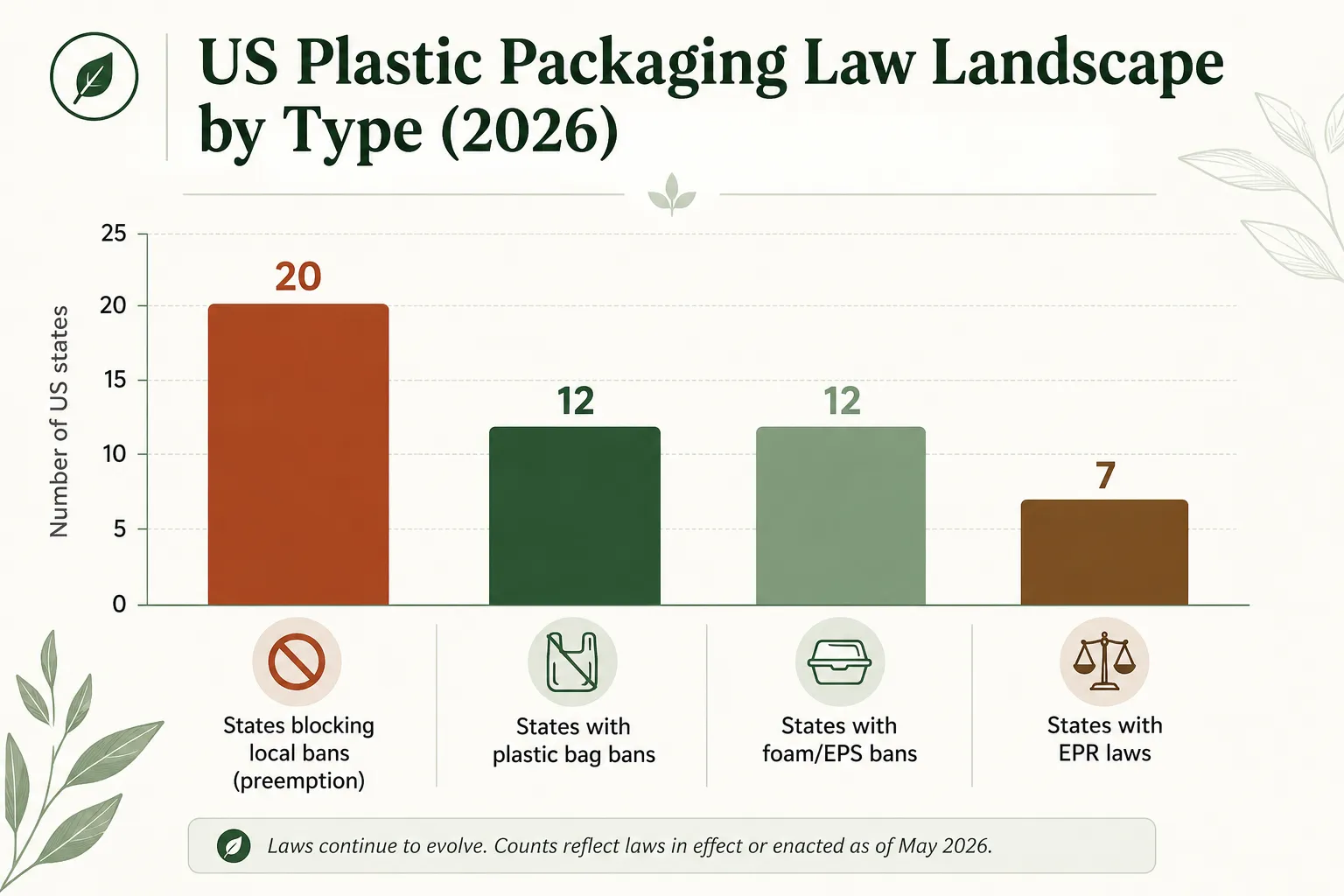
Bar chart comparing the number of US states with preemption laws, bag bans, foam bans, and EPR laws in 2026
Chart 1: More states currently block local plastic restrictions than have statewide bag bans — which is why a bakery in one city can face very different rules than a bakery one county over.
What This Means for Bakeries and Food Businesses Specifically
If you hand out takeout boxes, bags, cups, or utensils, several categories of state law can apply directly to you.
Foam takeout containers
This is the rule most likely to affect a bakery right now. Virginia’s polystyrene ban expanded to cover all food vendors on July 1, 2026, after initially applying only to chains with 20 or more locations — so it is already in force. Virginia’s ban covers plates, cups, bowls, trays, and hinged containers, carries civil penalties of up to $50 per day, and allows a vendor to request a one-year exemption from their locality on hardship grounds.
New York expanded its own foam ban in January 2026 to include cold storage containers like coolers and ice chests, on top of its existing foodware restrictions. Worth knowing: New York’s state ban excludes New York City, which enforces its own separate citywide rules — a good example of why checking your city matters.
Plastic utensils and condiments
Oregon’s SB 551, passed in 2025, stops food service businesses from automatically handing out single-use utensils and condiments — customers have to ask. That provision took effect in July 2026, so Oregon businesses should already be operating on a request-only basis.
Plastic checkout bags
If your bakery sells retail items alongside baked goods, checkout bag rules apply just as they do for grocery stores in states such as California, New York, and Washington. California tightened its rules significantly on January 1, 2026 under SB 1053, which closed the “thicker reusable bag” loophole and now permits only paper bags at checkout.
EPR reporting
If you produce or import your own branded packaging in volume — not just buy off-the-shelf boxes — you may be classified as a “producer” under EPR law in states like Oregon or Colorado, which means registration, reporting, and fees. Most small bakeries won’t cross that threshold, but the definitions vary by state and many carry small-business exemptions, so it’s worth checking rather than assuming either way.
This is why so many owners now look for plastic packaging compliance guidance for small food businesses — the rules were written with large retailers in mind, but small bakeries and cafés can get caught in the same net.
Deadlines That Already Passed in 2026
If you haven’t reviewed your packaging this year, start here. These are in force now:
| Date | What changed | Who it affects |
| Jan 1, 2026 | California SB 1053 — all plastic checkout bags prohibited, paper only | Retailers and food businesses in CA |
| Jan 1, 2026 | New York foam ban expanded to cold storage containers | Food businesses statewide (excl. NYC) |
| Jan 2026 | Colorado EPR producer fees became live | Covered producers in CO |
| Jul 1, 2026 | Virginia EPS ban expanded to all food vendors | Every food vendor in VA |
| Jul 2026 | Oregon SB 551 — utensils and condiments by request only | Food service in OR |
If any of these apply to you and you’re still using old stock, that’s the first thing to fix.
EPR: Who Actually Counts as a “Producer”?
EPR is the most misunderstood category, so it’s worth being precise. These laws make the company that puts packaging on the market responsible for the cost of recycling it. That’s usually the brand owner, not the bakery buying stock boxes from a supplier.
Two things matter for a small food business:
- Thresholds and exemptions. States set de minimis limits — Minnesota’s exemption, for example, applies to producers under one ton of packaging into the state or under $2 million in global revenue. Smaller operations often fall below the line entirely.
- Fees aren’t live everywhere yet. Enacted is not the same as invoicing.

Horizontal bar chart showing EPR producer fee start dates: Oregon 2025 and Colorado 2026 live, California 2027, Minnesota projected 2029, and Washington, Maryland, and Maine not yet set
Chart 2: Only Oregon (since July 2025) and Colorado (since January 2026) have live producer fees. California starts in 2027 and Minnesota’s fees are projected for 2029. Washington, Maryland, and Maine have no published fee schedule — and Maine has not yet designated a stewardship organization at all, after its tender closed in August 2026 without a bid.
The practical takeaway: the staggered rollout catches multi-state businesses off guard in both directions. Some assume they owe fees everywhere and panic; others assume EPR is years away and miss Oregon’s or Colorado’s live obligations. Check state by state.
Penalties are real where programs are active. California’s SB 54 allows penalties up to $50,000 per day for willful noncompliance, with a lower $25,000 per day cap for small producers. Oregon has been the most active enforcer so far.
Real Legal Battles Behind These Laws
These laws didn’t appear quietly. Courts and lobbyists have fought over almost every one of them.
In Ohio, the case State ex rel. Yost v. City of Athens saw the state sue its own city over a local bag ban. Ohio argued the city had no authority to pass it, the state prevailed, and the ruling became final in 2025 — a clear example of preemption being tested and upheld in court.
Texas offers the older precedent: in Laredo Merchants Association v. City of Laredo, the Texas Supreme Court ruled state law preempted the city’s ordinance, and bag bans across the state became unenforceable as a result.
In New York, a legal challenge to the state’s plastic bag ban argued the law conflicted with an older bag recycling statute and was unconstitutionally vague. The challenge failed and the ban stayed in place.
Industry opposition has been organized and well-funded. In New York, a 2025 report from the nonprofit Beyond Plastics found that more than 100 corporations lobbied against the state’s Packaging Reduction and Recycling Infrastructure Act, outnumbering supporters roughly four to one. In Florida, a 2025 bill that would have stripped cities of the power to regulate single-use plastics on public property was debated and ultimately postponed, though similar attempts are expected again. In California, consumer groups such as CALPIRG publicly welcomed the stronger 2026 bag rules as an overdue fix to the original law.
Compliant Material Alternatives
If you’re replacing foam or plastic, these are the categories suppliers actually stock:
| Material | Good for | Watch out for |
| Molded pulp / bagasse | Trays, clamshells, hot and cold items | Confirm compostability claims and certification |
| Recycled kraft board | Boxes, bags, sleeves | Needs a liner for greasy items |
| PLA / CPLA bioplastic | Cold cups, lids, utensils | Often needs commercial composting, not curbside |
| Paper with grease-resistant coating | Pastry boxes, liners | Confirm PFAS-free — several states now restrict PFAS |
| Aluminum / foil-lined | Hot takeout, bakes | Heavier; check recycling acceptance locally |
One genuinely important note: PFAS restrictions are a separate and growing category of law from plastic bans. Several states now limit intentionally added PFAS in food packaging, and grease-resistant coatings are exactly where PFAS historically showed up. When you replace foam, don’t accidentally buy into a different compliance problem — ask your supplier for PFAS-free documentation.
What It Costs to Switch
Compliance has a real price, and it’s fair to plan for it. Alternative materials like molded pulp or compostable plastics typically cost meaningfully more per unit than standard foam or plastic — often in the range of 20–50% more, though it varies widely by item and volume. On thin bakery margins, that’s a genuine strain.
Three ways to soften it:
- Switch during a reorder, not mid-stock. Running down existing compliant inventory first avoids paying twice.
- Right-size before you upgrade material. A smaller correct box often offsets much of the material premium.
- Buy the switch in bulk. Per-unit pricing drops with volume, so consolidating a material change into one larger order costs less than several small ones.
How to Stay Compliant Without the Guesswork
- Know your state’s specific list. Some states ban foam only; others ban bags, straws, and utensils together. Assuming “plastic-free” covers everything is a common, costly mistake.
- Check city-level rules too, especially in states without preemption laws — your city may go further than your state. New York City is a good example.
- Switch materials before the deadline, not after. Virginia’s expanded foam ban and New York’s cold-storage rule both had lead time built in for a reason.
- Ask your packaging supplier directly whether your boxes, bags, and liners are compliant in every state you operate in — don’t assume “eco-labeled” means legally compliant everywhere.
- Keep documentation. Material specs, PFAS statements, and compostability certifications are what you’ll need if anyone asks.
- Diarize the next deadlines. Compliance is a calendar problem more than a materials problem.
Pros and Cons of State Plastic Packaging Laws
| Pros | Cons |
| Reduces plastic waste ending up in landfills, rivers, and oceans | Alternative materials typically cost more, straining thin bakery margins |
| Pushes businesses toward recyclable and compostable packaging | Small businesses face registration and reporting burdens designed for large corporations |
| Creates more consistent sustainability expectations across an industry | Inconsistent state and city rules make multi-state compliance genuinely hard |
| Builds consumer trust for businesses that switch early, not last | Enforcement gaps can leave compliant businesses at a short-term price disadvantage |
Expert Tips at a Glance
- Treat compliance as a calendar, not a one-time switch — set reminders for the next effective dates in your states. 2. When you replace foam, ask for PFAS-free documentation in the same conversation. 3. In preemption states, check whether a local rule is actually enforceable before you act on it. 4. If you ship into other states, your obligations follow the destination, not just your home state. 5. Keep a one-page record of what each SKU is made of — it turns a compliance question into a five-minute answer.
Key Takeaways
- There is no federal plastic packaging law; every rule comes from a state or city.
- 12 states ban plastic bags, 12 ban foam foodware, 7 have EPR laws, and 20 preempt local rules.
- Foam bans are the rule most likely to affect a bakery today — Virginia’s expanded ban is now in force.
- EPR mainly affects branded producers, and only Oregon and Colorado are collecting fees so far.
- PFAS rules are a separate, growing category — check coatings when you switch materials.
- City rules can be stricter than state rules unless you’re in a preemption state.
Where Eco Packaging America Fits In
Most packaging suppliers sell boxes. Very few actually track packaging laws by state the way a compliance team does — cross-referencing bag bans, foam restrictions, PFAS limits, and EPR reporting rules against what a bakery actually uses day to day. That’s the gap Eco Packaging America closes: recyclable, compliant packaging paired with real guidance on what’s legal in your state, so you’re never caught off guard by a new law halfway through the year.
Frequently Asked Questions
How many US states currently ban single-use plastic bags? Twelve states have statewide bans on single-use plastic checkout bags: California, Colorado, Connecticut, Delaware, Hawaii, Maine, New Jersey, New York, Oregon, Rhode Island, Vermont, and Washington. Hawaii is unusual in that county ordinances rather than a single state law cover the whole state. Many cities layer stricter local rules on top, and most ban states also require a fee for paper or reusable replacements, typically between five and twelve cents. Always check your city as well as your state.
Which states have the strongest plastic packaging laws in 2026? California, Oregon, Washington, New York, and Maine generally have the most comprehensive combination of bag bans, foam bans, and EPR requirements. California tightened its bag rules in January 2026 by removing the thicker “reusable” plastic bag loophole, leaving paper only at checkout. Oregon has both an active EPR program with live producer fees and new utensil-on-request rules. If you operate in these states, assume the rules are stricter and change more often than average.
What is a preemption law, and how does it affect plastic bans? A preemption law blocks cities and counties from passing their own plastic restrictions, even if local voters want them. Twenty states currently preempt local bag regulation, with Florida, Texas, and Ohio among the most notable. These laws are often written broadly to cover “auxiliary containers,” meaning bags, foam, cups, and bottles all at once. The practical effect for a business is that a local ordinance in a preemption state may be unenforceable, so verify before you change anything based on a city rule.
Does my bakery need to worry about EPR packaging laws? Probably only if you put your own branded packaging on the market in volume rather than buying stock boxes from a supplier. Seven states have enacted EPR laws, but each sets its own definition of “producer” and its own de minimis exemption, and many small operations fall below those thresholds. Minnesota’s exemption, for instance, covers producers under one ton into the state or under two million dollars in global revenue. Check the specific state rather than assuming either way.
What happened in the Ohio bag ban court case? In State ex rel. Yost v. City of Athens, Ohio sued one of its own cities over a local plastic bag ban, arguing the city lacked authority to pass it under the state’s preemption law. The state prevailed and the ruling became final in 2025. It’s a clear demonstration that preemption laws are enforceable in practice, not just on paper. Texas set a similar precedent earlier when its Supreme Court found state law preempted Laredo’s ordinance, rendering bag bans across Texas unenforceable.
Are foam takeout containers banned everywhere? No. Twelve states currently ban polystyrene foam foodware, including California, New York, New Jersey, Maryland, Maine, Vermont, Colorado, Washington, Delaware, Oregon, Rhode Island, and Virginia. The list keeps growing, and existing bans keep expanding in scope. Virginia’s ban extended to all food vendors on July 1, 2026, and New York added cold storage containers in January 2026. Many cities also ban foam in states with no statewide rule, so check locally even if your state has no ban.
What are the penalties for non-compliance with EPR laws? Penalties vary by state and by program maturity. California’s SB 54 allows up to $50,000 per day for willful noncompliance, with a lower cap of $25,000 per day for small producers. Minnesota’s law provides for escalating penalties for repeat violations. In practice, most states in early enforcement years have prioritized getting producers registered and reporting over immediately penalizing first-time late filers, though Oregon has been notably more active in publicly identifying noncompliant producers.
Is there a federal plastic packaging law in the US? Not as of 2026. Every plastic packaging restriction currently comes from an individual state, county, or city, which is why requirements can differ sharply between neighboring states. Federal proposals have been introduced but none has become law. The practical consequence is that a business selling or shipping across state lines faces several separate rule sets rather than one national standard, and has to track obligations in every state it operates in or ships into.
What packaging materials are considered compliant alternatives to plastic? Common alternatives include molded pulp and bagasse, recycled kraft board, PLA and CPLA bioplastics, paper with grease-resistant coatings, and foil-lined options, depending on the specific state’s rules. Match the material to the food: greasy items need a liner, hot items need heat tolerance, and cold desserts need moisture control. Also confirm any coating is PFAS-free, since several states now restrict intentionally added PFAS in food packaging separately from their plastic rules.
Do these laws apply to online and delivery orders too? In most states, yes. Packaging rules generally apply regardless of whether food is served in-store, picked up, or delivered, because they target the container rather than the sales channel. If you ship into other states, obligations typically follow the destination as well as your home state, which matters for bakeries doing nationwide shipping. Review your delivery and shipping packaging alongside your in-store stock rather than treating them as separate compliance questions.
How can a small bakery stay updated on changing state packaging laws? Work with a packaging supplier that actively tracks state law changes, and treat compliance as a recurring calendar item rather than a one-time switch. Set reminders ahead of known effective dates, keep documentation of what each product is made of, and check both state and city rules when you expand into a new area. State environmental agency websites publish the authoritative requirements, and for anything with real financial exposure, confirm with a qualified attorney.
Why do plastic packaging laws vary so much between neighboring states? Because there’s no federal standard, each state legislature sets its own rules independently, so bordering states can have completely different requirements. Politics differ too: some states expand restrictions while others actively preempt local ones. The result is that a bakery near a state line can face two entirely different rule sets within a few miles, and a business that ships regionally has to track each destination separately rather than applying one policy everywhere.
Final Thoughts
Staying on top of packaging laws by state is less about memorizing every statute and more about knowing which categories apply to you: bags, foam, utensils, PFAS, and EPR. For most bakeries, foam and bag rules bite first, PFAS is the one people miss, and EPR only matters if you put your own branded packaging on the market at volume.
The businesses that handle this well treat it as a calendar, not a crisis — they know their state’s next effective date, they keep material documentation on file, and they switch during a normal reorder instead of scrambling after a deadline. Do that, and compliance becomes routine rather than a recurring surprise.
Not sure if your packaging is compliant? Eco Packaging America supplies recyclable kraft, molded pulp, and PFAS-free coated packaging for bakeries and food businesses across the US — and we’ll tell you straight whether what you’re using meets the rules in the states you operate in. Talk to our team for packaging built to meet today’s rules — and tomorrow’s.
About the Author
Eco Packaging America — Packaging Team. Custom Eco-Friendly Packaging Specialists for US Markets. With over 5 years of experience producing custom eco-friendly packaging for US food brands, bakeries, and e-commerce businesses, we’ve helped 200+ American brands create packaging that protects product and sells. We specialize in sustainable kraft, rigid, and mailer box solutions with low minimum orders and fast turnaround.