
Halloween isn’t just candy and costumes anymore. For US brands — bakeries, snack companies, chocolatiers, candle makers, gift shops, even skincare lines — it has become one of the biggest packaging seasons of the year. And the brands that stand out on shelves and in photos have one thing in common: packaging that looks like it was made for their product, not grabbed off a generic shelf.
This guide covers what a brand needs to know before placing a Halloween order: which box styles suit which products, what materials to use, how the three main Halloween design directions differ, what food safety requires if you’re packing anything edible, and the mistakes that cost brands money every October.
In This Guide
- Why custom packaging matters more at Halloween
- What “custom” actually means
- Choosing a box style for your product
- Materials, and when each is right
- Cute, spooky, or gothic: picking a direction
- Custom shapes and die cutting
- Print and finish options
- Food safety for edible products
- Timing and cost
- Common mistakes
Quick Answer
Custom Halloween packaging means the structure, the print, or both are built for your product rather than pulled from a catalogue. The four decisions that matter are box style (matched to what you’re packing), material (kraft, SBS, corrugated, or rigid), design direction (cute, classic spooky, or luxury gothic), and finish. Production runs approximately 12–15 business days after artwork approval, so most brands should be starting in August or early September.
Why Custom Packaging Matters More at Halloween
Scroll through Halloween product photos online. Boxes in plain orange with a printed spider sticker blend into each other. Boxes with a real design — brand colours, a shaped cutout, a window framing the product — are the ones people screenshot.

Custom packaging does three things a generic box can’t:
- It makes your product recognisable in a sea of orange and black.
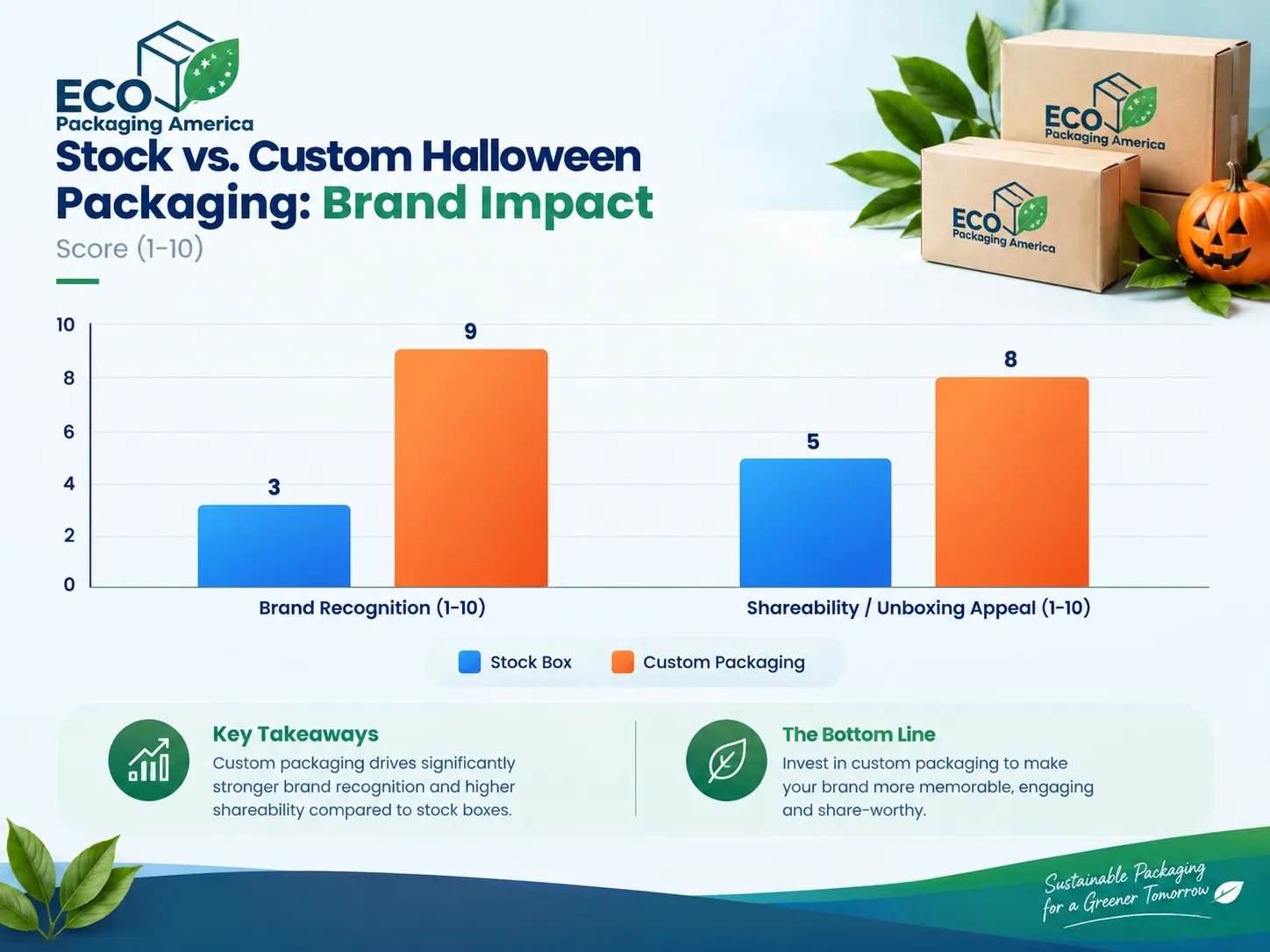
- It gives customers a reason to post about you. Seasonal packaging is photographed far more than everyday packaging.
- It signals care. A well-made box tells customers the product inside was made with the same attention.
There’s a commercial argument too, and it’s the one most brands underrate. A seasonal box is the cheapest way to create a limited edition. Same product, new packaging, a reason to buy now rather than later — and often a higher price point for the same contents.
What “Custom” Actually Means
A lot of brands think custom means adding a logo to a stock box. Real custom packaging has more layers, and skipping one usually produces packaging that looks right in the design file but fails once it’s printed and packed.
| Element | What it covers |
| Structure | Box style, dimensions, and how it holds the product securely |
| Material | Board weight and type, eco options, food-safe stock where needed |
| Print design | Colours, artwork, theme, logo placement |
| Finish | Matte, gloss, soft-touch, spot UV, foil, embossing |
| Functionality | Window cutouts, handles, inserts, tuck flaps, custom shapes |
Choosing a Box Style for Your Product
Start from what you’re packing, not from the catalogue. This is the fastest route to the right answer.
| Product | Suitable styles | Why |
| Candy and small treats | Treat bag, pillow box, tuck box, gable box | Light contents, high volume, retail display |
| Chocolate and bonbons | Rigid, magnetic rigid, two-piece, sleeve and tray | Premium presentation, needs cavity support |
| Cupcakes and bakery | Window box, tuck box, gable | Shows off decoration, needs food-safe stock |
| Cookies and assortments | Sleeve and tray, two-piece, window box | Keeps items separated and presentable |
| Candles | Rigid, mailer, tuck box with insert | Glass needs structural protection |
| Cosmetics and skincare | Rigid, magnetic, two-piece, tuck | Premium unboxing, small precise fit |
| Gifts and hampers | Rigid, magnetic, gable, two-piece | Presentation is the product |
| Ecommerce shipments | Mailer box | Built for transit rather than shelf |
| Retail counter display | Display box, gable | Designed to be seen from the front |
If you sell more than one of these, resist the urge to force everything into a single box style. Two well-chosen styles usually cost less in wasted product than one compromise.
Materials, and When Each Is Right
| Material | Best for | Notes |
| Kraft board | Artisan and eco-led brands | Warms printed colours; naturally recyclable look |
| SBS / C1S paperboard | Bright, colour-accurate printing | Clean white base; best for vivid artwork |
| Corrugated (E/B flute) | Shipping and heavier products | Structural strength for transit |
| Rigid board (1.5–3mm) | Premium gifting, chocolate, cosmetics | Substantial feel; highest perceived value |
| Food-grade PFAS-free stock | Anything in direct contact with food | Required for candy, chocolate, bakery |
| Recycled and FSC-certified | Sustainability-led brands | Certified fibre sourcing |
A note worth knowing: your board changes your colours. The same artwork printed on kraft looks warmer and earthier than on white SBS. If your brand has exact colours to hit, that decision matters as much as the ink.
Cute, Spooky, or Gothic: Picking a Direction
Most Halloween packaging falls into one of three directions, and picking one deliberately is what separates a considered seasonal range from a generic orange box.
Cute — friendly ghosts, smiling pumpkins, pastel oranges and purples. Suits bakeries, children’s treats, and family-facing brands. Photographs well and doesn’t alienate anyone.
Classic spooky — bats, webs, silhouettes, traditional orange and black. The most broadly recognised direction and the safest choice for retail, where a customer needs to register “Halloween” in a second.
Luxury gothic — deep blacks, matte finishes, foil detail, restrained typography. Suits chocolate, candles, cosmetics, and premium gifting. This is the direction that lets a brand do Halloween without looking childish, and it’s the one most often underused.
Pick the direction before the artwork, not during. Most revision rounds we see come from a brand that started designing before deciding which of these three it wanted.
Custom Shapes and Die Cutting
Beyond printing, the box itself can be shaped — pumpkin, bat, coffin, and haunted house are the four most requested. Shaped windows are a lighter-touch alternative: a standard box with the window cut into a bat or pumpkin silhouette, which gives the seasonal signal without changing the structure.
Two practical points. A custom shape needs a new dieline built and checked, so it adds time at the design stage even where there’s no extra tooling charge. And shaped boxes have structural limits — the more material you cut away, the less the box holds its form under weight or stacking. If you’re shipping rather than displaying, discuss the shape before you commit to it.
Print and Finish Options
Printing methods vary by run size and colour accuracy: offset CMYK for larger runs and photographic artwork, digital for shorter runs and faster turnaround, and PMS spot colour matching where a brand colour has to be exact. Inside printing — artwork on the inner face of the box — is a low-cost way to make the opening moment feel deliberate.
For finishes:
- Matte lamination — soft, premium, hides handling marks. The safest choice for dark Halloween artwork.
- Gloss lamination — vivid and eye-catching, but shows fingerprints, especially on black.
- Soft-touch — velvety feel, strong on premium and gothic ranges.
- Spot UV — selective gloss on a matte background. Effective for webs, drips, and logo detail.
- Foil stamping — metallic detail. The single most effective upgrade on a gothic range.
- Embossing and debossing — raised or recessed detail, adds texture without adding colour.
- Grease-resistant coating — necessary for buttery bakes and some confectionery.
Food Safety for Edible Products
If your product is eaten, the packaging has requirements beyond looking good. Anything in direct contact with food should be FDA food-grade and PFAS-free, and printing should be specified so inks stay clear of food-contact surfaces.
This matters more at Halloween than people expect, because seasonal artwork tends to be heavy on ink coverage and dark colours, and because greasy bakery items and buttery confectionery are exactly the products that test a board’s coating. Specify food-grade stock at the quote stage rather than discovering the problem at proofing.
Timing and Cost
Production runs approximately 12–15 business days from final artwork approval, plus roughly a week beforehand for quoting, design, and proof approval. Working backwards from 31 October, that puts the comfortable order window in August and early September.
On cost, the factors that move the number are quantity, box style, material, size, print method, finishes, and whether a custom die is involved. Setup costs are fixed regardless of run size, so per-unit price falls as quantity rises — which is why the same box can look expensive at 250 units and reasonable at 2,000.
The upgrades that add the most perceived value for the least money tend to be inside printing, a spot UV detail, and a well-chosen matte finish. Foil and rigid construction cost more and are best reserved for premium and gift lines where customers already expect them.
Common Mistakes
- Starting artwork before choosing a direction. Cute, spooky, and gothic pull in different directions; deciding late means redesigning.
- Designing for the screen, not the box. Artwork that ignores fold lines ends up with logos creased down the middle.
- Forgetting height. Brands measure width and depth and forget the lid has to close over frosting, a candle wick, or a topper.
- Choosing gloss for dark artwork. Black plus gloss equals visible fingerprints on every box a customer touches.
- Leaving food-grade stock as an afterthought. It changes the material spec, so it belongs in the first conversation.
- Ordering the whole range instead of one hero product. One well-packaged SKU outperforms a thin seasonal treatment across everything.
- Starting too late. The most common and the most expensive.
Pros and Cons of Going Custom
| Pros | Cons |
| Stronger brand recognition on shelves and online | Longer lead time than plain stock packaging |
| Higher perceived value, supporting a seasonal price | Higher upfront cost, especially at small quantities |
| More control over material and sustainability choices | Requires design input and decisions from your team |
| Better protection, since the box fits your product | Limited flexibility once the season is underway |
| A more shareable unboxing moment | Seasonal artwork can’t be reused next season |
Working With Us
A few things that are included as standard and affect how the process runs:
- Free design support, dieline creation, and 3D mockups, so you see how the box will look before production begins.
- Free custom die cutting — shaped boxes don’t carry an extra tooling charge, though they do need dieline time.
- Free shipping to all 50 states.
- FDA food-grade, PFAS-free stock available for edible products.
- Kraft, recycled, and FSC-certified options for brands with sustainability requirements.
- Rush options when the date is tight.
Frequently Asked Questions
What counts as “custom” Halloween packaging? Custom means the box structure, the print design, or both are made for your brand rather than selected from a generic catalogue. That can be as simple as your artwork printed on a standard tuck box, or as involved as a bespoke dieline cut into a pumpkin silhouette with foil detailing. The distinction that matters commercially is fit: custom packaging is built around your product’s actual dimensions, which is why it protects better than a generic box the product merely fits inside.
How long does custom Halloween packaging take to produce? Production runs approximately 12–15 business days from final artwork approval, with roughly a week before that for quoting, design, and proof approval. Simpler specifications move faster; custom dies, foil, and multiple proofing rounds add time. Working backwards from 31 October, most brands should be starting the conversation in August or early September to have stock in hand for the peak selling window that opens on 1 October.
Can small brands afford custom Halloween packaging? Yes, though the economics differ from a large run. Setup costs are fixed regardless of quantity, so the per-unit price is highest at small volumes and falls as the run grows. For a small brand, the practical approach is to put custom packaging behind one hero product rather than spreading it thinly across a whole range. That keeps the order size manageable while still giving you a seasonal product that looks properly considered.
Is custom packaging more expensive than stock packaging? Per unit, usually yes, and the gap is widest at small quantities. It narrows significantly at volume as fixed setup costs spread across more units. The comparison is also not quite like for like: custom packaging is sized to your product, which reduces damage, and it supports a seasonal price point that plain packaging doesn’t. Weigh the unit cost against reduced breakage and the price you can charge for a limited edition.
Can custom Halloween packaging be eco-friendly? Yes. Recyclable kraft, recycled board, and FSC-certified stock are all standard options, and right-sizing the box to the product cuts material use while protecting better than an oversized box. One thing to check rather than assume: some finishes and coatings affect whether a box is accepted in normal recycling streams. If a recyclability claim is going on the packaging itself, confirm the full specification supports it before printing it.
What information do you need to start a custom order? Product dimensions including height, the quantity you need, your logo as a vector file, brand colours (PMS values if you have them), your preferred box style, and your deadline. Any special features — windows, inserts, custom shapes, foil — should be raised at this stage rather than later, since they affect both the dieline and the timeline. Sending all of it in the first message typically removes several days from the process.
How many design revisions are normal? It varies with how settled the brand’s artwork is at the start. Brands that arrive with a finalised direction and a vector logo often approve on the first or second proof; brands still deciding between design directions take longer. Each round adds time, so the most useful thing you can do is agree internally on the theme and colours before the first proof rather than using proofing as the decision process.
Can I combine Halloween design with my regular brand packaging? Yes, and it’s often the smartest option. Many brands keep their core box structure and swap the printed artwork for the season, which keeps the structure familiar and the cost down. A lighter version of the same idea is to keep the box entirely unchanged and add a printed sleeve, belly band, or label for the season — that gives you a seasonal look at a fraction of the cost and a much shorter lead time.
Does custom packaging protect products better than stock boxes? Generally yes, because it’s built around your product’s exact dimensions rather than being a generic size the product happens to fit. Excess space is where items slide, tip, and crush, so a snug fit prevents damage that no amount of extra board thickness will. For fragile seasonal items — decorated cupcakes, bonbons, glass candle vessels — the fit and the insert matter considerably more than the strength of the outer box.
Can Halloween packaging be reused for other seasons? The structure often can; the print usually can’t. If you’re planning several seasonal ranges, choose a box style that works year-round and change only the artwork — or better, keep one core printed box and change a sleeve or label each season. That approach lets you run four seasonal looks a year without four separate box orders, and it keeps your brand recognisable across all of them.
When should brands start planning Halloween packaging? Ideally July or August, with artwork finalised by late August and the order placed in early September. That leaves all of October for selling rather than waiting on delivery. Planning that early also keeps options open that a tight timeline closes off — custom shapes, specialty finishes, and time for a physical sample before committing to the full run. Brands that start in October are usually choosing from what’s still achievable rather than what they wanted.
What’s the biggest mistake brands make? Starting too late, followed closely by starting the artwork before deciding on a design direction. Both produce the same outcome: compromises made under time pressure. The brands that end up with packaging they’re happy with tend to have made three decisions early — which product gets the seasonal treatment, which of the three design directions they’re using, and what their real in-hand date is. Everything after that is execution.
Final Thoughts
Custom Halloween packaging is one of the most straightforward ways for a US brand to stand out during the busiest retail stretch of the autumn. It takes more planning than buying a stock box, but the decisions are not complicated: match the box style to the product, pick a material that suits the artwork, choose one of the three design directions and commit to it, and specify food-grade stock if anything edible is going inside.
Get those four right and the rest is execution. Start the conversation early enough and you’ll be choosing what you actually want rather than what’s still possible.
Planning your Halloween range? Send us your product dimensions, quantity, and logo, and we’ll recommend the right box style and material — with a free 3D mockup so you can see it before anything goes to print. Explore custom Halloween packaging or request a quote.
About the Author
Eco Packaging America — Packaging Team. Custom Eco-Friendly Packaging Specialists for US Markets. We produce custom packaging for US food brands, bakeries, confectioners, candle makers, and e-commerce businesses, specialising in sustainable kraft, rigid, and mailer box solutions with free design support and fast turnaround.