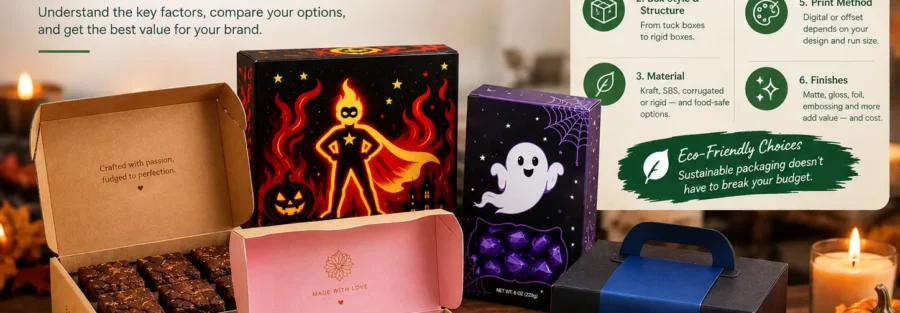
“How much will this actually cost?” It’s the first question every brand asks once the Halloween design ideas start flowing. It’s also the hardest one to answer in a blog post, because custom packaging isn’t priced from a catalogue — it’s priced from your specification.
What we can do is show you exactly which choices move the number, which ones move it the most, and where you can cut cost without cutting quality. Once you understand those levers, a quote stops being a mystery number and becomes something you can predict and control.
Quick Answer
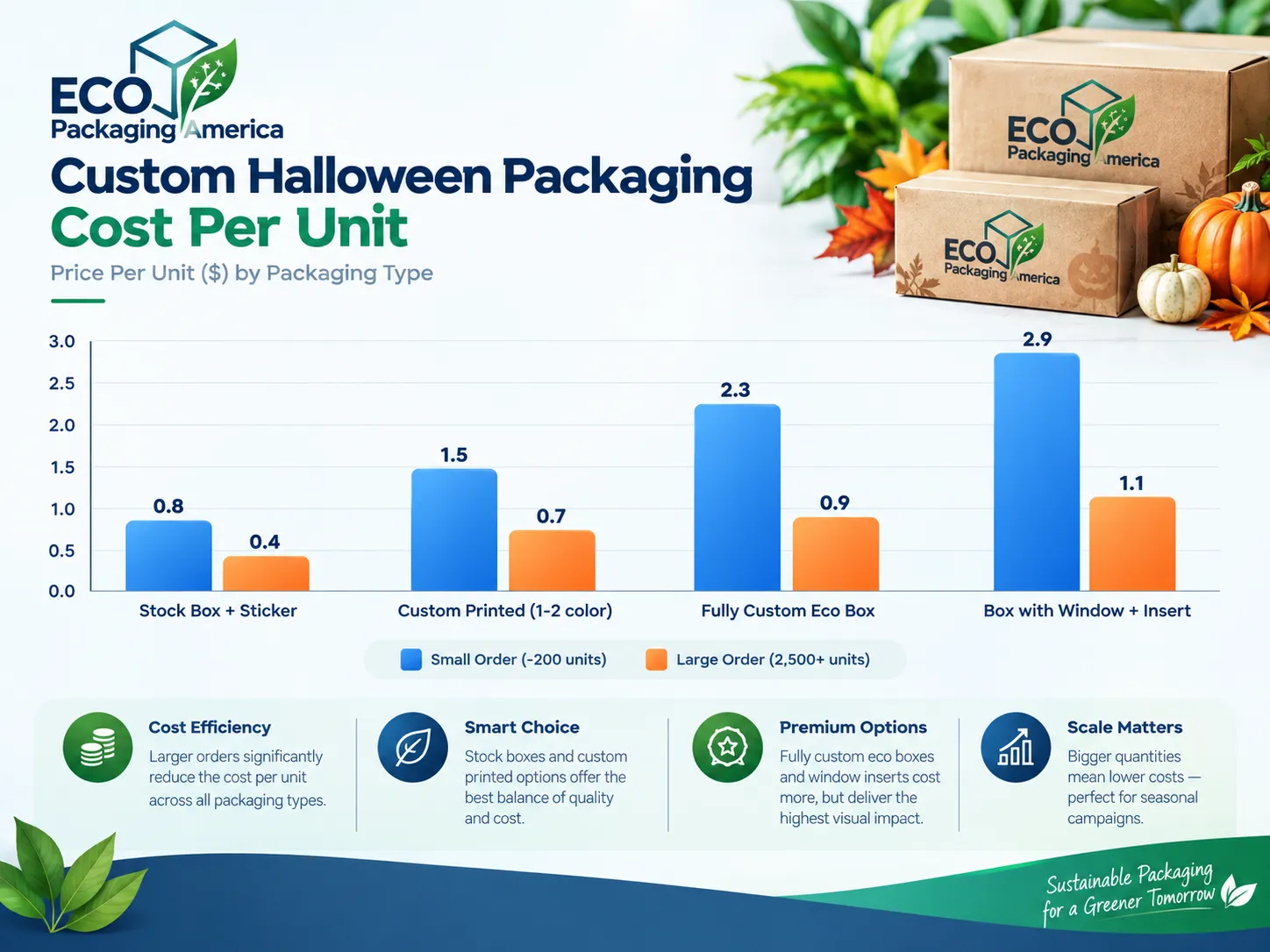
Custom Halloween packaging is priced per unit based on six variables: quantity, box style, material, size, print method, and finishes. Quantity is by far the biggest lever — setup costs are fixed regardless of run size, so the same box can cost twice as much per unit at 250 pieces as at 2,500. There’s no meaningful catalogue price for custom work, so the fastest route to a real number is sending dimensions, quantity, and artwork for a quote.
Why There’s No Price List
Two brands can order what looks like “the same box” and receive very different quotes. That isn’t inconsistency — it’s what custom means. A 6×6×3 kraft tuck box in one colour and a 6×6×3 rigid box with a window, insert, and foil logo are different products that happen to hold the same cupcake.
This is also why you should be cautious of any supplier publishing firm per-unit prices for custom packaging without seeing your specification. A number quoted before anyone knows your dimensions, quantity, or finish is a number that will change.
The Six Things That Move Your Price
1. Quantity — the biggest lever by far
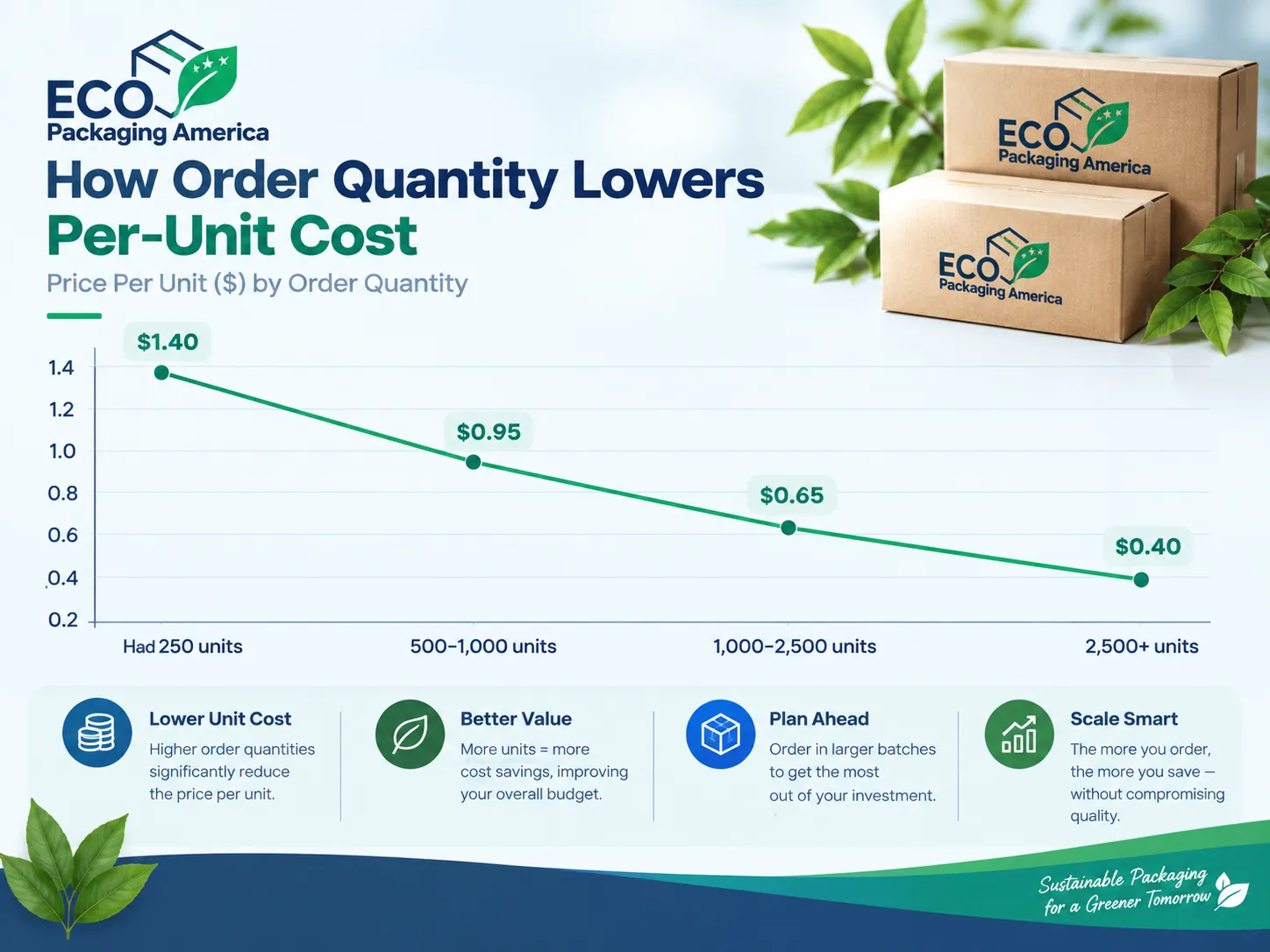
Setup costs — dieline creation, plate setup, press configuration — are largely fixed whether you print 250 boxes or 5,000. Those costs spread across the run, so per-unit price drops sharply as quantity rises, then flattens out.
The practical consequence: the jump from a very small run to a moderate one usually delivers the largest saving you’ll ever get on the same box. If you’re weighing 250 against 1,000, ask for both quotes before deciding — the difference per unit is often larger than brands expect, and the total difference smaller.
2. Box style and structure
Structure drives cost more than artwork does. Roughly in ascending order:
| Structure | Relative cost | Notes |
| Tuck end box | Lowest | The workhorse; suits most products |
| Pillow box, treat bag | Low | Light contents, simple construction |
| Window box | Low–medium | Adds a cut and a film application |
| Gable box | Medium | Built-in handle adds material and steps |
| Sleeve and tray | Medium | Two components instead of one |
| Mailer box | Medium | Corrugated, built for transit |
| Two-piece box | Medium–high | Base and lid, more material |
| Rigid / magnetic rigid | Highest | Thick board, hand assembly, premium feel |
3. Material
Kraft and SBS paperboard sit at the affordable end. Corrugated costs more but is necessary for shipping. Rigid board is the most expensive by a clear margin because it uses more material and more labour.
Food-grade PFAS-free stock, needed for anything touching candy, chocolate, or bakery items, is a specification requirement rather than an upgrade — budget for it from the start if your product is edible rather than treating it as optional.
One genuine myth worth correcting: recycled and FSC-certified board are not automatically more expensive than conventional board. Kraft in particular is often the most economical choice available, which is why “eco” and “budget” frequently point at the same option rather than opposite ones.
4. Size
Bigger boxes use more board, so they cost more — but the effect is less linear than people assume, because a slightly larger box may still be cut from the same sheet. What genuinely wastes money is an oversized box: you pay for material you don’t need, then pay again in shipping weight and dimensional pricing, and risk damage because the product slides. Right-sizing is one of the few decisions that lowers cost and improves protection at the same time.
5. Print method and colours
One or two spot colours cost less than full CMYK. Full-coverage artwork — a box printed edge to edge in black, for instance — uses more ink than a design with white space. PMS spot matching for an exact brand colour adds a step. Digital printing suits short runs; offset becomes more economical as quantity climbs.
If budget is tight, one-colour printing on kraft is the single most cost-effective route to a box that still looks deliberate and branded.
6. Finishes
| Finish | Relative cost | Best value for money |
| Matte or gloss lamination | Low | Strong — matte especially, on dark artwork |
| Inside printing | Low | Excellent — big impact on unboxing, small cost |
| Spot UV | Medium | Good — targeted detail rather than whole surface |
| Embossing / debossing | Medium | Good on logos |
| Soft-touch lamination | Medium | Strong on premium ranges |
| Foil stamping | Highest | Best reserved for gift and premium lines |
What’s Included Without Extra Charge
Worth knowing before you budget, because some of these are charged separately elsewhere:
- Design support and dieline creation
- 3D mockups before production
- Custom die cutting — shaped boxes like pumpkin, bat, coffin, and haunted house carry no extra tooling charge, though the dieline does take time
- Shipping to all 50 states
- 20% discount on first orders
The die-cutting point matters for budgeting. A custom shape is usually assumed to be a premium upgrade; here the cost sits in design time rather than tooling, which changes the maths on whether a shaped box is worth it.
Where to Save Without Hurting Quality
In rough order of how much they save relative to what they cost you:
- Increase the quantity if you can genuinely use it. The per-unit saving typically outweighs everything else on this list combined.
- Simplify the structure, not the material. A sturdy tuck box beats a flimsy rigid box. Cut the structural complexity before you cut board quality.
- Reduce colours rather than coverage. One or two well-chosen colours on kraft reads as intentional design, not as a budget compromise.
- Use a sleeve or band instead of a fully printed box. Keeps a plain box year-round and puts the seasonal print on a cheaper component.
- Right-size the box. Saves material and shipping at once.
- Concentrate the budget on one hero product rather than spreading a thin seasonal treatment across the whole range.
What not to cut: food-grade stock on edible products, and board weight on anything fragile. Both cost far more in damaged product than they save.
Small Order or Large Order?
| Smaller order | Larger order | |
| Pros | Lower total outlay · Less risk if the design changes next year · Good for testing a new design | Much lower per-unit cost · More options become economical · No mid-season stockout |
| Cons | Higher cost per unit · Custom features are harder to justify · May run out at peak | Higher upfront outlay · Needs storage · Seasonal artwork can’t be carried over |
The seasonal factor tilts this differently than it would for year-round packaging. A box printed with Halloween artwork has a four-week selling window and no use in November, so the dead-stock risk is real in a way it isn’t for your standard packaging. Base the quantity on last season’s actual unit sales rather than an optimistic forecast.
How to Get an Accurate Quote Quickly
Send these in the first message and you’ll usually get a real number rather than a request for more information:
- Product dimensions, including height
- Quantity — and a second quantity if you want to compare
- Box style, or a description of the product if you’re unsure
- Material preference, and whether the contents are edible
- Print requirements: number of colours, or PMS values
- Any finishes you’re considering
- Your deadline
If you’re comparing options, ask for the quote at two quantities and with one finish swapped. That shows you the shape of the pricing curve, which is far more useful than a single number.
Want a real number for your specification? Send your dimensions, quantity, and artwork and we’ll quote it properly — including where we’d suggest saving if the budget is tight. Request a quote and a free 3D mockup.
Frequently Asked Questions
What is the average cost of custom Halloween packaging? There isn’t a meaningful average, because custom packaging is priced from your specification rather than a catalogue. A simple one-colour kraft tuck box and a rigid magnetic box with foil and an insert are different products at very different prices, even at the same quantity. The variables that decide your number are quantity, box style, material, size, print method, and finishes. The fastest route to a real figure is sending dimensions, quantity, and artwork for a quote.
Does ordering in bulk really lower the price that much? Yes, and it’s the biggest single lever you have. Setup costs such as dieline creation and plate setup are largely fixed regardless of run size, so they spread across more units as quantity rises. The steepest saving usually comes in the jump from a very small run to a moderate one, after which the curve flattens. If you’re weighing two quantities, ask for both quotes — the per-unit gap is often wider than brands expect.
Is eco-friendly packaging more expensive than regular packaging? Not necessarily, and this is one of the more persistent myths in packaging. Kraft board is frequently among the most economical options available, and recycled and FSC-certified stock are standard choices rather than specialty orders. What does add cost is layering specialty coatings or finishes on top. If sustainability and budget are both priorities, a simple kraft box with one-colour printing usually satisfies both at once.
What’s the cheapest way to add a Halloween theme to packaging? A printed sleeve, belly band, or label applied to your existing box. You keep one box design year-round and change only the cheaper seasonal component, which also shortens lead time considerably. The next most economical route is one-colour seasonal printing on kraft. Both look deliberate rather than improvised, which matters — a thin seasonal treatment that looks like an afterthought does less for your brand than doing nothing.
Do rush orders cost more? Rush production is available and typically carries a cost, but it’s worth understanding what it can and can’t do. Rushing moves your job up the production queue; it can’t skip dieline creation, proofing, or transit. If your artwork isn’t finalised, paying to rush doesn’t help because the delay sits upstream of the factory. Simplifying the specification often buys more time than a rush fee does — and saves money rather than adding it.
What packaging feature adds the most cost? Rigid construction, followed by foil stamping. Rigid boxes use substantially more board and require hand assembly, which is why they sit at the top of the structural cost range. Foil is a separate press operation. Both are worth it for premium and gift lines where customers expect that level of finish, and both are usually the first things to reconsider if a quote comes back above budget. Inserts and windows add cost more modestly.
Can small brands get custom packaging without a huge minimum order? Smaller runs are possible, though the economics change: per-unit price is highest at low quantities because fixed setup costs spread across fewer boxes. For a small brand, the practical approach is to put custom packaging behind one hero product rather than across the whole range. That keeps the order size manageable while still producing a seasonal item that looks properly made. Ask about the minimum for your specific box style, as it can vary.
Is it cheaper to reuse the same design each Halloween? Yes. Once a dieline exists and artwork is approved, repeat orders skip the design and setup stages, which removes both time and cost. This is a strong argument for getting the first year right rather than rushing it — a design you’re happy to reuse for three seasons is considerably cheaper across those seasons than three different designs. It also builds recognition, since returning customers start associating the packaging with your brand.
Does box shape affect the price? Structure affects price significantly — a rigid box costs far more than a tuck box. Custom die-cut shapes are a particular case: there’s no extra tooling charge for a pumpkin, bat, coffin, or haunted house die, so the cost sits in design time rather than the die itself. That makes shaped boxes more affordable than most brands assume. What shapes do require is lead time for the dieline to be built and checked, so plan for that rather than adding it late.
Are sample orders worth the extra cost before a bulk order? For most brands, yes — particularly on dark artwork, custom shapes, or anything with a tight fit. A sample confirms colour, fit, and structure before you commit to the full run, and the cost of a sample is trivial next to the cost of reprinting a few thousand boxes that came out wrong. A 3D mockup is included before production and catches many issues, but it can’t show you how the finish feels or how the box behaves when loaded.
When should I request a quote? As early as your specification allows. Quoting early doesn’t just help with budget — it gives you time to adjust the specification if the first number is above what you wanted, which is much harder to do close to a deadline. It also keeps options open that a tight timeline closes off, such as custom shapes or a physical sample. For Halloween, most brands should be quoting in July or August.
What’s the best way to lower costs without hurting quality? Raise the quantity if you can genuinely use it, simplify the structure rather than the material, and reduce the number of print colours rather than the coverage. Keep board weight and food-grade stock where they matter, since both cost more in damaged product than they save. And consider putting the seasonal print on a sleeve rather than the box — it’s the single cheapest route to a seasonal look that still reads as designed.
Final Thoughts
Custom Halloween packaging cost isn’t one number, and any supplier who gives you one before seeing your specification is guessing. It’s a combination of quantity, structure, material, size, print, and finish — and once you know which of those matter most, you can shape a quote to fit your budget rather than hoping it lands there.
If a first quote comes back higher than you wanted, the productive question isn’t “can you do it cheaper?” It’s “which part of this is costing the most, and what would it look like without it?” That’s a conversation any good supplier should be willing to have.
About the Author
Eco Packaging America — Packaging Team. Custom Eco-Friendly Packaging Specialists for US Markets. We produce custom packaging for US food brands, bakeries, confectioners, candle makers, and e-commerce businesses, specialising in sustainable kraft, rigid, and mailer box solutions with free design support and fast turnaround.