Packaging matters more than most bakery owners realize — and honestly, most customers never think about it at all. Here’s a simple test: when someone gives directions to a bakery, nobody says “go to the place with the blue box.” They say “go to New York Bakery,” or “it’s the one downtown near the barber shop,” or “it’s right by the 7-Eleven.” The name and the location stick. The box doesn’t.
So why do smart bakery owners still invest in custom boxes? Because the box isn’t really for the customer walking in — it’s for building the brand behind the counter. A custom box carries your logo, your colors, and your identity every time a customer walks out the door, posts a photo, or hands a gift to a friend. Some well-known bakeries even charge extra for a custom-printed box. Customers happily pay for it, and the brand still gets free marketing on top. That’s a business that understands what its packaging is really worth.
This guide covers everything a US bakery needs to know about custom bakery boxes and the right sizes for every product — what they are, why they matter, exact box dimensions for cakes, donuts, cupcakes, croissants, and macarons, how to pick the right material, eco-friendly trends and state laws, what really drives the price, and how to choose a supplier you can trust.

In This Guide
- What custom bakery boxes are (and your finishing options)
- Why custom packaging matters for bakeries
- The complete bakery box size guide — cake, donut, croissant, cupcake, macaron
- How to measure your product for the right box
- Choosing the right material
- Print finishes and what they signal
- Food safety & FDA basics
- Eco-friendly packaging trends & US state laws
- What actually drives the price
- How to choose a packaging supplier
- Frequently asked questions
What Are Custom Bakery Boxes?
Custom bakery boxes are packaging designed around your brand and your products, rather than a generic box you buy off a shelf. At a minimum they usually carry:
- Your business logo
- Your address or contact details (a quiet reorder prompt)
- A size and shape built for the specific product — cakes, donuts, cupcakes, croissants, macarons, and more
Beyond size and branding, you can add finishing options depending on your budget and brand:
- Color printing — single color or full four-color (CMYK)
- UV spot coating — a glossy highlight that catches the eye
- Lamination — matte or gloss, for durability and a premium feel
- Embossing — a raised, textured logo
- Offset printing — high-quality, detailed graphics
- Window cut-outs — so customers see the product before opening
- Foil stamping — a metallic, upscale finish for gift and wedding lines
Which of these you choose depends entirely on your requirements, budget, and brand identity. You don’t need all of them — you need the right one or two for the impression you want to make.
Why Custom Packaging Matters for Bakeries
Packaging matters to customers more than most owners assume. Two reasons stand out:
- Every box that leaves the store is a small billboard for your business — on the counter, in a car, on someone’s kitchen table, and all over social media.
- A clean, professional, well-printed box signals a business that cares about quality — and that builds trust before the customer even tastes the product.
Here’s a simple way to see it: if packaging didn’t matter, the biggest brands in the world would just use plain, unbranded boxes and bags. They don’t. That alone tells you how much weight packaging carries.

The research backs it up. In a national Ipsos survey for the Paper and Packaging Board, about 72% of US consumers said packaging design can influence what they buy — and for gifts, that jumps to roughly 81%. The same study found about 63% feel paper and cardboard packaging makes a product seem premium, and 69% say it makes it feel more artisanal or handcrafted. For a bakery selling “handmade,” the box is telling that story before anyone opens it.
| Why it pays back
Packaging isn’t only a cost. Roughly 40% of shoppers will photograph and share packaging that looks unique or gift-like (Dotcom Distribution) — free reach. And a 2024 Ryder study found 41% of US online shoppers said a great unboxing made them want to buy again, rising to about 60% for shoppers under 30. |
The Complete Bakery Box Size Guide
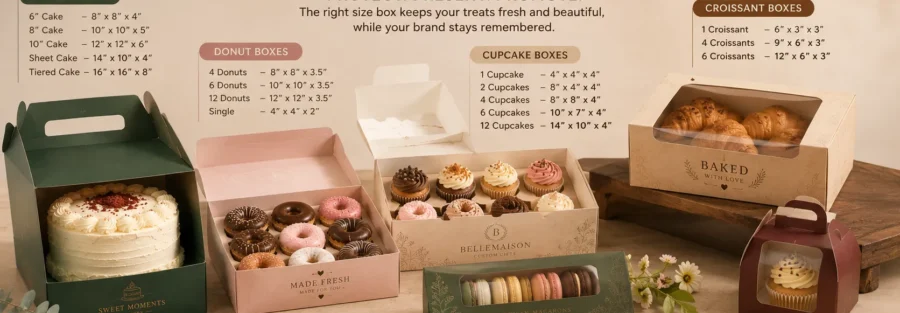
Getting the size right isn’t just about looks. The right box protects the product, prevents damage in transit, and keeps everything presentable when the customer opens it. Too big and the product slides and smears; too small and it gets crushed. Below are the standard sizes used across the US bakery industry.
1. Cake Boxes
| Cake Size | Box Size (L × W × H) |
| Small (6″ cake) | 8″ × 8″ × 4″ |
| Medium (8″ cake) | 10″ × 10″ × 5″ |
| Large (10″ cake) | 12″ × 12″ × 6″ |
| Sheet cake | 14″ × 10″ × 4″ |
| Tiered / wedding cake | 16″ × 16″ × 8″ |
Tall cakes need a locking or reinforced base so the box doesn’t bow under the weight.
2. Donut Boxes
| Quantity | Box Size (L × W × H) |
| 4 donuts | 8″ × 8″ × 3.5″ |
| 6 donuts | 10″ × 10″ × 3.5″ |
| 12 donuts (1 dozen) | 12″ × 12″ × 3.5″ |
| Single donut (window box) | 4″ × 4″ × 2″ |
3. Croissant Boxes
| Quantity | Box Size (L × W × H) |
| Single croissant | 6″ × 3″ × 3″ |
| 4 croissants | 9″ × 6″ × 3″ |
| 6 croissants | 12″ × 6″ × 3″ |
4. Cupcake Boxes
| Quantity | Box Size (L × W × H) |
| 1 cupcake | 4″ × 4″ × 4″ |
| 2 cupcakes | 8″ × 4″ × 4″ |
| 4 cupcakes | 8″ × 8″ × 4″ |
| 6 cupcakes | 10″ × 7″ × 4″ |
| 12 cupcakes (1 dozen) | 14″ × 10″ × 4″ |
Most cupcake boxes use an insert or divider tray, so each cupcake sits in its own slot and frosting doesn’t smear against the box or the cupcake next to it.
5. Macaron Boxes
| Quantity | Box Size (L × W × H) |
| 6 macarons | 6″ × 3″ × 2″ |
| 12 macarons | 8″ × 4″ × 2″ |
| 24 macarons | 10″ × 6″ × 2″ |
Macaron boxes are narrow and shallow on purpose. Macarons are delicate, and a snug, shallow fit keeps them from shifting and cracking in transit.
How to measure your product for the right box
If your product isn’t a standard size, measure it yourself — it takes two minutes and prevents expensive mistakes:
- Measure the product at its widest and tallest points, including any wrapper, liner, or decoration.
- Add clearance. Leave about ¼–½ inch on each side so the product doesn’t rub the walls, and enough height so a lid or dome doesn’t crush frosting.
- Account for inserts. If you use a divider tray, measure with it in place.
- Order a sample first. Approve a physical box before a full run — screens and spec sheets don’t show fit.
| Quick pricing myth
It’s a common myth that custom boxes are always cheaper (or always pricier) than standard ones. Neither is true. The real cost depends on the material, the finishing, and how much customization you choose — not simply the word “custom.” |
Choosing the Right Material
Material decides how your box looks, how well it protects the product, and what it costs. Here are the four you’ll actually choose between:
| Material | Best For | Cost | Strength | Eco | Premium Feel |
| Kraft paper | Everyday, artisan look, cookies | Low | Low–Med | Excellent | Medium |
| Folding carton (paperboard) | Cupcakes, donuts, retail packs | Low–Med | Medium | Good | Medium |
| Corrugated | Cakes, heavy items, shipping | Medium | High | Good | Med–High |
| Rigid (set-up) box | Weddings, gifts, premium sets | High | High | Good | Very High |
Rule of thumb: kraft and folding cartons cover most everyday bakery needs; step up to corrugated when the product is heavy or shipping, and to rigid when the box itself is part of the gift.
Print Finishes and What They Signal
You don’t need every finish — just the one that matches your brand. In short:
- Matte lamination — understated and modern; scuff-resistant.
- Gloss / UV spot — makes colorful cakes and cupcakes pop.
- Foil stamping — gold or silver shine for gift and wedding lines.
- Embossing — a raised logo that reads “craftsmanship” with no ink at all.
- Kraft + one color — the most cost-effective way to look artisanal.
Food Safety & FDA Basics
A complete guide has to cover this, because not every printed box is safe for direct food contact. In the US, the FDA regulates the materials that touch food rather than approving each finished box. Paperboard, corrugated board, inks, coatings, and adhesives that may contact food are treated as “food contact substances” and must be authorized for that use — the rules live in 21 CFR Parts 174–186.
You don’t need to memorize the regulations. You just need to ask your supplier the right questions:
- Are the paperboard and corrugated materials compliant with 21 CFR 174–186 for food contact?
- Are the inks and coatings food-safe and approved for indirect food contact?
- Do you offer food-grade kraft or a liner where product touches the box directly (oily or refrigerated items)?
- Can you provide a materials compliance declaration if a retailer or marketplace asks?
A reputable US supplier will have clear answers and documentation ready. If they can’t confirm any of this, treat it as a red flag.
Eco-Friendly Packaging Trends & US State Laws
Eco-friendly packaging isn’t an overnight trend. It has a long history in the US, starting in the 1960s, gaining real momentum from the 1990s, and surging from 2018 onward:
- 1960s–1970s — the start of environmental awareness in the US.
- 1980s–1990s — the recycling movement went nationwide.
- 2000s — sustainability shifted from “nice to have” to a business strategy.
- 2018–present — eco packaging hit the mainstream, driven by plastic-pollution awareness, the explosion of online shopping, and customers actively choosing greener products.
This is also where the money is heading. The US sustainable packaging market was worth about $49 billion in 2024 and is projected to reach roughly $74 billion by 2034 — around a 50% jump — with paper and fiber-based formats leading the growth (Towards Packaging). And about 41% of US consumers say they’ll pay more for products in sustainable packaging (Two Sides). For a bakery, natural kraft and recyclable board are exactly what buyers want.
Several states have also restricted single-use plastics, which pushes bakeries toward sustainable packaging. As of early 2026, twelve states have statewide single-use plastic bag bans. Here’s where a few of the biggest stand:
| State | Restriction (as of early 2026) | Example Cities |
| California | First statewide bag ban (2016); as of Jan 2026 all plastic checkout bags eliminated; foam foodware banned (2025) | Los Angeles, San Diego, San Jose |
| New York | Statewide single-use plastic bag ban since 2020; paper-bag fee optional by county | New York City, Buffalo, Rochester |
| New Jersey | Among the strictest — bans plastic AND paper bags plus foam at stores over 2,500 sq ft (since May 2022) | Newark, Jersey City, Paterson |
| Washington | Statewide plastic bag ban; fees on paper and reusable bags | Seattle, Spokane, Tacoma |
| Colorado | Single-use plastic bag and foam container bans fully enforced (2024) | Denver, Colorado Springs, Aurora |
| Oregon | Thin plastic bags banned (2020); thicker “reusable” plastic bags banned from 2027 | Portland, Salem, Eugene |
| Vermont | Restricts plastic bags, straws (on request), and foam containers | Burlington, S. Burlington, Rutland |
| Maine | Statewide single-use plastic bag ban | Portland, Lewiston, Bangor |
Plastic and packaging laws change often and vary by city. Verify the current rules for your state and county before switching materials.
For a bakery, this isn’t just background — it’s a practical reason to move toward eco-friendly boxes, especially if you operate in one of these states.
What Actually Drives the Price
Every bakery — from a small local shop to a wholesale supplier — wants packaging that’s affordable without cutting quality. The price of a custom bakery box isn’t fixed; it moves with a few key factors:
- Kraft paper is usually the most budget-friendly and eco-conscious. Corrugated adds strength and protection for heavier items. Rigid boxes deliver a premium, high-end look at a higher price.
- Lamination, embossing, UV spot coating, and foil stamping each add to the base cost.
- Color count. One of the biggest drivers. More print colors means higher cost — a single-color job will always beat a full four-color design on price.
- Per-unit cost drops sharply as volume climbs. A box that’s pricey at 100 units gets much cheaper at 1,000, because setup is spread across more boxes.
Understanding this lets you make informed choices instead of assuming “custom” automatically means expensive or cheap — it genuinely depends on what you pick.
How to Choose a Packaging Supplier
We’re not here to push one specific company. What matters is knowing what to check before you commit. Look for:
- Where they’re based and where production happens. A company might be registered in Austin, Texas, but print in South Asia, the UK, or elsewhere. Knowing this tells you real shipping times and how quality control works.
- Free design support. A good supplier helps you design the box — not just print whatever file you send.
- Free (or fair) shipping. It can make a real difference to your total packaging budget.
- Fast, clear communication. Quick, straight answers are a strong sign of a reliable partner.
- Food-grade proof. They should confirm FDA-compliant, food-safe materials and provide documentation on request.
- Low minimums & realistic lead times. Expect a 100–500 minimum per design and about 2–3 weeks for a first run.
- Protected payment. Secure methods like PayPal protect your money if something goes wrong.
Checking these before you place an order saves a lot of time, money, and frustration later.
Expert Tips at a Glance
| Five things we tell every bakery client
1. Size to the product plus ¼–½” clearance; order a physical sample before the full run. 2. Use insert trays for cupcakes and macarons — cheap insurance against smears and cracks. 3. Match material to weight and storage: kraft/paperboard everyday, corrugated for heavy or shipping. 4. Confirm food-grade materials in writing (21 CFR 174–186). 5. Print your contact or a reorder QR on the box — turn one sale into repeat business. |
Key Takeaways
- The box is a branding tool first — a small billboard that builds trust and free social reach.
- Right-size every product (with ¼–½” clearance) and use inserts for cupcakes and macarons.
- Standard sizes: 1 dozen cupcakes = 14×10×4; 1 dozen donuts = 12×12×3.5; 8″ cake = 10×10×5.
- Material, finishing, color count, and quantity drive price — not the word “custom.”
- Confirm food-grade materials (FDA 21 CFR 174–186) before ordering.
- 12 states now have statewide plastic bag bans, and 41% of US buyers pay more for sustainable packaging — eco boxes are an asset.
Frequently Asked Questions
What are custom bakery boxes made of?
Most custom bakery boxes are made from kraft paper, corrugated cardboard, or rigid board, sometimes as printed folding cartons. The right choice depends on the product and the protection or presentation you need: kraft for an everyday artisan look, corrugated for heavier items or shipping, and rigid for premium gift and wedding packaging. Whatever the material, confirm it’s food-grade for anything that touches the product directly, and add a liner for oily or refrigerated items.
What size box do I need for a dozen cupcakes?
A standard box for 12 cupcakes is about 14″ × 10″ × 4″, almost always paired with an insert or divider tray so each cupcake sits in its own slot. The insert keeps frosting from smearing against the box or the cupcake next to it during transport. For smaller counts, 6 cupcakes fit a 10″ × 7″ × 4″ box, 4 fit an 8″ × 8″ × 4″, and a single cupcake fits a 4″ × 4″ × 4″ box.
What size box do I need for a cake?
It depends on the cake’s diameter and height. As a quick reference: a 6″ cake fits an 8″ × 8″ × 4″ box, an 8″ cake fits 10″ × 10″ × 5″, and a 10″ cake fits 12″ × 12″ × 6″. Sheet cakes commonly use 14″ × 10″ × 4″, and tiered or wedding cakes need a tall, sturdy box around 16″ × 16″ × 8″. Always leave a little clearance and use a reinforced base for taller cakes.
What size box for a dozen donuts?
A dozen donuts fits a standard 12″ × 12″ × 3.5″ box. Six donuts fit 10″ × 10″ × 3.5″, four fit 8″ × 8″ × 3.5″, and a single donut works in a small 4″ × 4″ × 2″ window box for grab-and-go or gifting. The shallow height keeps donuts from stacking and getting squashed, and a window box lets customers see the product before they open it.
Why do macaron boxes need to be shallow?
Macarons are delicate and crack easily if they shift or stack during transport. A shallow, snug-fitting box holds each shell in place so it can’t move. Standard sizes are 6″ × 3″ × 2″ for 6 macarons, 8″ × 4″ × 2″ for 12, and 10″ × 6″ × 2″ for 24. Many bakeries add an insert with individual wells for extra protection and a more premium presentation.
Are custom bakery boxes more expensive than regular boxes?
Not necessarily. It’s a myth that custom boxes are automatically pricier (or cheaper). The real cost depends on the material, the number of print colors, the finishing options, and the order quantity — not simply whether the box is custom. A single-color kraft box at volume can be very affordable, while a foil-stamped rigid box costs more. Per-unit price also drops sharply as your order quantity increases, since setup is spread across more boxes.
Are custom bakery boxes food safe?
They are when made from food-grade materials. In the US, the FDA regulates the paperboard, inks, and coatings that contact food under 21 CFR Parts 174–186. Ask your supplier to confirm the materials are food-safe and to provide a compliance declaration if needed. For oily or refrigerated products, add a grease-resistant liner or coating, since bare, uncoated paper can absorb moisture and soften or stain over time.
Is eco-friendly bakery packaging required by law in the USA?
It depends on your state. There’s no single federal rule, but as of early 2026, twelve states — including California, New York, New Jersey, and Washington — have statewide single-use plastic restrictions, and several also limit foam containers. These laws mostly target bags and foam rather than bakery boxes directly, but they push businesses toward sustainable packaging overall. Laws change often and vary by city, so check the current rules where you operate before switching materials.
What’s the minimum order, and how long does it take?
Most suppliers require a minimum of about 100–500 boxes per design, and a first custom order usually takes around 2–3 weeks from approved artwork to delivery — longer for rigid boxes or special finishes like foil. Reorders of an existing design are faster because the dieline and print files already exist. Build in extra time before holidays and product launches, when demand and lead times rise, and ask about rush options if you’re tight.
How do I know if a packaging supplier is trustworthy?
Look for free design support, clear and fast communication, and transparency about where production actually happens (a US address doesn’t always mean US printing). A reliable supplier confirms food-grade, FDA-compliant materials, offers secure payment methods like PayPal, and provides samples before a full run. Reasonable minimums and honest lead times are good signs too. Checking these points before you order protects your budget and avoids delays or quality surprises down the line.
The Bottom Line
Custom bakery boxes are more than something to carry a product home — they’re a quiet but powerful branding tool that builds trust, protects your product, and reflects the quality of your business. From choosing the right size for cakes, donuts, cupcakes, croissants, and macarons, to picking the right material and reading the eco-friendly trends across the US, every decision shapes how customers see your bakery.
| Ready to get the right box for every product?
At Eco Packaging America, we help US bakeries pick the right size, material, and finish — with food-grade, eco-friendly options, low minimums, and fast turnaround. Tell us your product, quantity, and any size questions, and we’ll send a no-pressure quote and a sample recommendation. Request your free custom bakery box quote today — and start building a brand customers remember, one box at a time. |