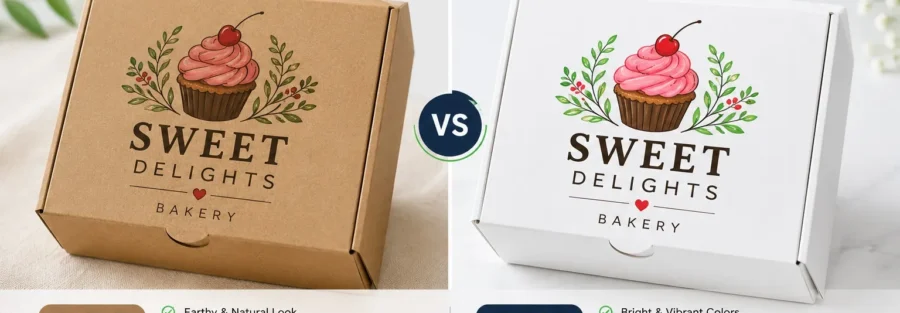
Choosing the right bakery box packaging isn’t just about looks — it affects your brand image, your costs, and even how customers perceive your products before they take a single bite. Two of the most popular choices are kraft bakery boxes and white bakery boxes. Both have loyal fans, and both come with real trade-offs.
In this guide, we’ll break down the differences honestly — no fluff, no one-size-fits-all answers — so you can pick what actually fits your bakery’s brand, budget, and customer expectations.
At Eco Packaging America, we manufacture custom bakery boxes for businesses across the US every day, from small home bakeries to large commercial brands. This guide is based on real production experience — the material trade-offs, cost differences, and sizing decisions we walk our clients through on a regular basis.
In This Guide
- Why bakery box packaging matters more than you think
- Regional usage trends across the US
- What kraft bakery boxes are (pros & cons)
- What white bakery boxes are (pros & cons)
- Quick comparison table
- Small bakeries vs big brands: who uses what
- Cost analysis by box size (kraft vs white)
- Why custom printing is the real differentiator
- Frequently asked questions

Why Bakery Box Packaging Matters More Than You Think
Before comparing materials, it’s worth understanding why this decision matters at all. Packaging influences buying decisions far more than most bakery owners realize — one industry report found that a large majority of US consumers say packaging design plays a role in their purchase decisions, meaning your box is essentially a silent sales pitch before a customer ever tastes your product.
Sustainability is also becoming a bigger factor. The US sustainable packaging market was valued at roughly $49 billion in 2024 and is projected to climb to around $74 billion by 2034, with paper and fiber-based packaging — like kraft — leading that growth (Towards Packaging). On the consumer side, about 41% of US buyers say they’re willing to pay more for products in sustainable packaging (Two Sides), a strong argument for eco-friendly bakery packaging if you want to stand out.
Regulation is nudging things in kraft’s direction too: as of early 2026, twelve US states have statewide single-use plastic bag bans, and more cities and counties add local restrictions each year. For bakeries in these states, sustainable bakery boxes aren’t just a branding choice anymore — they’re becoming a practical necessity.
Regional Usage Trends Across the US
There’s no single verified national database that tracks kraft vs white bakery box usage state-by-state, so treat the notes below as general market patterns rather than exact statistics — but the trend lines are fairly consistent across the custom bakery boxes wholesale market:
| Tendency | States | What’s driving it |
| Lean Kraft | California, Oregon, Washington, New York, Colorado, Massachusetts | Plastic-bag bans, eco-conscious consumers, and a high concentration of artisan / small-batch bakeries |
| Lean White | Texas, Florida, Georgia, and parts of the Midwest (Ohio, Illinois, Michigan) | More commercial bakery chains, grocery bakery counters, and cake shops that prioritize print vibrancy and brand consistency |
If you’re targeting a specific state or region, it’s worth checking local plastic-packaging regulations — they can directly affect which material makes more sense for you.
What Are Kraft Bakery Boxes?
Kraft bakery boxes are made from unbleached, recycled paperboard, giving them that natural brown, rustic look. They’ve become extremely popular in recent years, especially among bakeries leaning into an eco-friendly, handmade, or artisanal brand identity.
Pros of kraft bakery boxes
- Eco-friendly appeal — made from recycled or sustainably sourced material, kraft is widely seen as the “greener” choice.
- Rustic, artisanal aesthetic — the natural brown tone gives a homemade, premium feel that suits cookies, pastries, artisan bread, and farmers-market products.
- Cost-effective — kraft paperboard is generally cheaper to produce than bleached white board, lowering your packaging costs.
- Durable and grease-resistant — kraft tends to be sturdy and holds up well during transport and delivery.
Cons of kraft bakery boxes
- Limited print contrast — bright colors and detailed designs don’t always pop on brown kraft; light-colored logos can look washed out.
- Not ideal for every brand — if your bakery is modern, minimalist, or luxury-positioned, kraft’s rustic look may not match your tone.
- Stain visibility varies — uncoated kraft can show grease spots unless treated with a food-grade barrier coating.
What Are White Bakery Boxes?
White bakery boxes are typically made from SBS (Solid Bleached Sulfate) paperboard, giving them a clean, bright, polished appearance. They’re the classic choice you’ll see in most traditional bakeries, cake shops, and commercial packaging.
Pros of white bakery boxes
- Clean, professional look — a crisp, premium presentation, great for cakes, cupcakes, macarons, and delicate pastries.
- Better print vibrancy — colors, logos, and detailed designs show up sharper on white, especially with foil stamping, spot UV, or embossing.
- Versatile branding — works across almost any brand style: modern, elegant, minimalist, or colorful.
- Familiar to customers — white bakery packaging is widely recognized and can feel more “commercial-grade” or premium to some buyers.
Cons of white bakery boxes
- Higher production cost — bleaching paperboard adds to manufacturing costs, so white boxes are often pricier than kraft.
- Less eco-friendly perception — even when recyclable, bleached board is viewed as less sustainable by eco-conscious customers.
- Shows dirt/damage more easily — scuffs, fingerprints, and grease stains are more visible on white than on kraft brown.
Kraft vs White Bakery Boxes: Quick Comparison
| Factor | Kraft Bakery Boxes | White Bakery Boxes |
| Look & feel | Rustic, natural, artisanal | Clean, polished, premium |
| Print vibrancy | Moderate (colors can look muted) | High (colors pop clearly) |
| Eco-friendly perception | Strong | Moderate |
| Cost | Generally lower | Generally higher |
| Best for | Artisan bakeries, cookies, farmers markets | Cake shops, cupcakes, modern brands |
| Stain visibility | Lower on brown surface | Higher on white surface |
Small Bakeries vs Big Brands: Who Actually Uses What?
Business size and scale often shape this decision as much as personal taste does.
Small bakeries and kraft boxes
- Lower upfront cost matters more when you’re ordering smaller quantities.
- Kraft naturally supports the “handmade, local, artisan” story most small bakeries tell.
- Farmers markets, pop-ups, and local delivery customers respond well to the eco-friendly, rustic look.
Big brands and white boxes
- Bulk ordering brings the cost-per-unit difference down, making white’s higher base cost less of a factor.
- Consistent, vibrant brand colors matter more at scale — a national brand needs its logo identical across thousands of boxes.
- White boxes photograph better for marketing, social media, and in-store displays.
That said, this isn’t a hard rule. Plenty of small bakeries choose white for a premium cake line, and some large eco-focused brands use kraft as their primary packaging to reinforce a sustainability-first identity. The real deciding factor is brand positioning, not just business size.
Cost Analysis by Box Size (Kraft vs White)
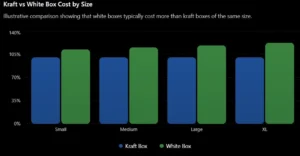
Custom bakery box pricing depends on quantity, printing complexity, coating, and finish — so treat the numbers below as typical starting ranges for bulk custom-printed orders (500–1,000 units), not fixed quotes. Kraft generally runs 10–20% cheaper than white at the same size and print complexity.
Cake boxes
| Size (L × W × H) | Kraft (per unit) | White (per unit) |
| 6″ × 6″ × 4″ (mini cake) | $0.45 – $0.65 | $0.55 – $0.80 |
| 8″ × 8″ × 4″ (small cake) | $0.55 – $0.80 | $0.70 – $0.95 |
| 10″ × 10″ × 5″ (medium cake) | $0.70 – $0.95 | $0.85 – $1.15 |
| 12″ × 12″ × 6″ (large cake) | $0.90 – $1.20 | $1.05 – $1.40 |
| 14″ × 14″ × 6″ (tiered / party) | $1.10 – $1.45 | $1.30 – $1.70 |
Donut boxes
| Size (L × W × H) | Kraft (per unit) | White (per unit) |
| 4″ × 4″ × 3″ (single donut) | $0.25 – $0.35 | $0.30 – $0.45 |
| 6″ × 6″ × 3″ (mini 4-pack) | $0.35 – $0.50 | $0.45 – $0.60 |
| 8″ × 8″ × 3.5″ (half-dozen) | $0.45 – $0.65 | $0.55 – $0.80 |
| 10″ × 10″ × 3.5″ (dozen) | $0.55 – $0.80 | $0.70 – $0.95 |
| 12″ × 12″ × 4″ (family box) | $0.70 – $0.95 | $0.85 – $1.15 |
Croissant boxes
| Size (L × W × H) | Kraft (per unit) | White (per unit) |
| 6″ × 6″ × 3″ (2-pack) | $0.35 – $0.50 | $0.45 – $0.60 |
| 8″ × 8″ × 3″ (4-pack) | $0.45 – $0.65 | $0.55 – $0.80 |
| 9″ × 4″ × 3″ (single, elongated) | $0.30 – $0.45 | $0.40 – $0.55 |
| 10″ × 5″ × 3.5″ (2–3 pack) | $0.40 – $0.55 | $0.50 – $0.70 |
| 12″ × 8″ × 4″ (6-pack) | $0.60 – $0.85 | $0.75 – $1.00 |
Cupcake boxes
| Size (cavity count) | Kraft (per unit) | White (per unit) |
| Single cavity (4″ × 4″ × 4″) | $0.30 – $0.45 | $0.40 – $0.55 |
| 2-cavity (8″ × 4″ × 4″) | $0.40 – $0.55 | $0.50 – $0.70 |
| 4-cavity (9″ × 9″ × 4″) | $0.55 – $0.75 | $0.65 – $0.90 |
| 6-cavity (10″ × 7″ × 4″) | $0.65 – $0.90 | $0.80 – $1.05 |
| 12-cavity (14″ × 10″ × 4″) | $0.90 – $1.20 | $1.10 – $1.45 |
General industry-style estimates for planning. Actual pricing depends on order volume, board thickness (GSM), number of print colors, and finishing such as window cutouts, foil stamping, or matte/gloss lamination. For an exact quote on custom bakery boxes wholesale, get a size-specific breakdown from your manufacturer.
Custom Printed Bakery Boxes: The Real Differentiator
Regardless of which base material you choose, what actually builds brand recognition is custom printing — your logo, brand colors, and messaging on the box itself. A generic kraft or white box does the job functionally, but a custom-printed box turns your food-grade packaging into free marketing every time a customer opens it (or posts it on social media).
At Eco Packaging America, we manufacture both kraft and white bakery boxes with full custom printing, sizing, and finishing options — so you’re not stuck choosing between sustainability and branding. You can have both.
Expert Tips at a Glance
| Five things we tell every bakery client
1. Pick the material to match your brand story first — artisan/eco leans kraft, polished/colorful leans white. 2. For cakes, use 300–400 GSM board so the box supports the weight without bowing. 3. If bright, light-colored logos are core to your brand, white reproduces them far more accurately. 4. Add a food-grade barrier coating on kraft for oily items to prevent grease spotting. 5. Mix both: kraft for everyday items, white for premium cake or gift lines — align packaging to each product. |
Key Takeaways
- Kraft wins on sustainability appeal and cost; white wins on print vibrancy and polished presentation.
- Kraft is unbleached recycled paperboard; white is bleached SBS — both can be food-grade and recyclable.
- Kraft typically runs 10–20% cheaper than white at the same size and print complexity.
- Small/artisan bakeries lean kraft; commercial chains lean white — but brand positioning matters more than size.
- Use 300–400 GSM board for cakes, and a food-grade barrier coating on kraft for oily items.
- Custom printing — not the base color — is what actually builds brand recognition.
Frequently Asked Questions
Are kraft bakery boxes more eco-friendly than white bakery boxes?
Generally, yes. Kraft paperboard is unbleached and typically uses fewer chemical processes to manufacture, which is why it’s perceived — and often is — the more sustainable option. However, white boxes made from FSC-certified, recyclable board can still be a responsible choice if sustainability isn’t your top priority. The gap is about the bleaching process and eco perception, not whether the box can be recycled.
Which is cheaper: kraft or white bakery boxes?
Kraft bakery boxes are usually 10–20% cheaper than white at the same size and print complexity, mainly because bleaching paperboard adds to production costs. The exact gap depends on order volume, board thickness, print colors, and finishing. At higher volumes the per-unit difference narrows, which is part of why larger brands are less sensitive to white’s higher base cost than small bakeries ordering smaller runs.
Do kraft boxes work for cakes, or are they only for cookies and pastries?
Kraft works well for cakes too, especially for bakeries with a rustic or artisan brand identity. For cakes, just make sure the box has adequate structural support — a good rule is 300–400 GSM kraft paperboard to handle the weight without bowing. Pair it with a sturdy base and, for cream or buttercream cakes, a grease-resistant liner so the box stays clean and structurally sound in transit.
Can I get vibrant, colorful designs printed on kraft boxes?
Yes, but colors will look more muted and earthy on kraft compared to white, since kraft is a natural brown tone rather than a blank white canvas. Bold, light, or pastel colors especially can look washed out. If bright, accurate branding is essential to your business, white bakery boxes will give you far more accurate color reproduction — or you can use a white ink underbase on kraft for specific elements.
Do bakery boxes need to be food-grade certified?
Yes. Any bakery box that comes into direct contact with baked goods should be food-grade to ensure it’s safe for food contact and meets FDA packaging standards (21 CFR Parts 174–186). This applies to both kraft and white boxes and covers the board, inks, and any coatings. Ask your supplier to confirm food-grade materials and provide a compliance declaration if a retailer or marketplace requests one.
Is it okay to use both kraft and white boxes for different products?
Absolutely. Many bakeries use kraft for everyday items (cookies, donuts, croissants) and white for premium or specialty items (custom cakes, gift boxes). It’s a smart way to align packaging with each product line’s brand positioning without overcomplicating your supply chain. Keeping a consistent logo and print style across both keeps the brand cohesive even when the base material changes between product lines.
Which bakery box looks more premium — kraft or white?
Both can look premium; they just signal it differently. White reads as clean, polished, and “commercial-grade,” which suits modern, elegant, or luxury cake brands and shows off foil and spot-UV finishes. Kraft reads as artisanal, natural, and handcrafted, which feels premium for small-batch, organic, or farmers-market positioning. The more premium choice is whichever matches your brand story — a mismatch is what makes packaging feel cheap, not the color.
Are white bakery boxes recyclable?
Yes. White SBS paperboard is recyclable, and choosing FSC-certified stock makes it a responsible option even though it’s bleached. The main knock against white on sustainability is perception plus the bleaching process, not recyclability. If you want the polished look of white but a stronger eco story, ask about FSC-certified board, recycled-content options, and water- or soy-based inks, and say so clearly on the box.
What board thickness (GSM) should I use for bakery boxes?
It depends on the product’s weight. For cakes and heavier or tiered items, 300–400 GSM keeps the box rigid so it won’t bow. Cookies, donuts, and lighter pastries do fine on thinner board. Larger boxes generally need higher GSM to stay sturdy. Your manufacturer can recommend the right thickness for each size and product — over-speccing wastes money, while under-speccing risks crushed or sagging boxes in transit.
Does kraft or white photograph better for social media?
White generally photographs brighter and makes colorful cakes, cupcakes, and detailed logos pop, which is why brands investing heavily in visual marketing often prefer it. Kraft photographs warm and rustic, which is exactly the mood artisan, organic, and farmers-market brands want. Neither is objectively better — pick the one whose look matches the aesthetic your audience follows you for, and keep lighting and styling consistent across posts.
Why Trust This Guide: Our Experience with Bakery Packaging
Eco Packaging America has spent years manufacturing custom packaging for US bakery businesses, working directly with owners on decisions exactly like this one. A few things that shape our expertise on kraft vs white bakery boxes:
- Hands-on manufacturing experience — we produce both kraft and white boxes in-house, across dozens of sizes and finishes, so the pros, cons, and cost differences here come from actual production runs, not just theory.
- Direct client feedback — we work with everything from single-location home bakeries to multi-city commercial brands, giving us a firsthand view of how business size and scale affect material choice.
- Material and compliance knowledge — we stay current on food-grade packaging standards, FDA requirements, and state-level plastic regulations that affect what bakeries can and should use.
- Real cost data — our pricing guidance reflects what we actually quote clients for custom bakery boxes wholesale, not generic averages pulled from unrelated markets.
If you want packaging guidance based on real manufacturing experience rather than guesswork, our team is always happy to walk through your specific product line, volume, and budget.
Final Thoughts
Kraft and white bakery boxes each bring something different to the table. Kraft wins on sustainability appeal and cost; white wins on print vibrancy and polished presentation. The right choice depends on your bakery’s brand story, your business size, and what your customers expect when they open the box.
| Not sure which fits your business best?
Reach out to our packaging team for a free consultation and sample quote. We manufacture both kraft and white bakery boxes with full custom printing, sizing, and finishing — so we’ll help you figure out what works for your product line and budget, sustainability and branding included. Request your free consultation and sample quote today. |
About the Author
Eco Packaging America — Packaging Team. Custom Eco-Friendly Packaging Specialists for US Markets. With over 5 years of experience producing custom eco-friendly packaging for US food brands, bakeries, and e-commerce businesses, we’ve helped 200+ American brands create packaging that sells. We specialize in sustainable kraft, rigid, and mailer box solutions with low minimum orders and fast turnaround.