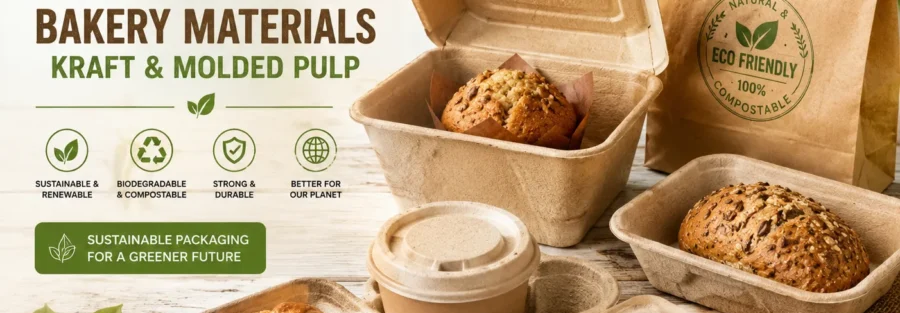
Before we get into it, it helps to understand what eco-friendly bakery packaging actually is. That’s the only way to see why the packaging trend is shifting worldwide, and why more and more bakeries are moving toward sustainable boxes, bags, and trays.
The easiest way to understand a topic is to break it into its parts. So we’ll take the phrase “eco-friendly bakery packaging is becoming the new industry standard” and split it into two ideas: “eco-friendly packaging” and “bakery packaging.” At Eco Packaging America, we think customers deserve to actually understand what they’re buying and why. Without real product knowledge, we can’t guide you properly — and you can’t make a confident decision either.
In This Guide
- What eco-friendly packaging is
- What eco-friendly bakery packaging is
- Plastic restrictions around the world (US, EU, UK, Canada)
- How eco packaging became the standard — and what the data shows
- States leading the shift
- Benefits of switching
- Common eco-friendly materials compared
- Frequently asked questions
What Is Eco-Friendly Packaging?
Eco-friendly packaging is nothing like traditional plastic. Plastic can take decades — even centuries — to break down, and in the meantime it adds heavily to pollution. Eco-friendly packaging is designed to break down naturally (biodegradable) or be recycled into new material instead.
Its defining characteristics:
- Biodegradable material — breaks down naturally over time.
- Recyclable — after use, the material can be processed into new packaging.
- Minimal material use — less waste and less excess.
- Non-toxic inks — no harmful chemical residue left behind.
Common eco-friendly materials
- Kraft paper
- Corrugated cardboard
- Molded pulp boxes and trays
- Seed paper (for tags and inserts)
- Jute and cotton fabric (for reusable bags)
Why it matters
- Customers increasingly prefer environmentally conscious brands.
- Plastic-packaging restrictions are being introduced across many countries.
- It strengthens overall brand image.
- Long-term costs can actually be lower as demand grows and plastic gets regulated.
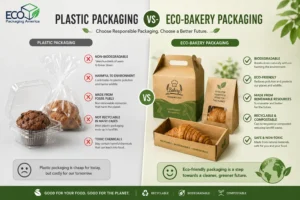
What Is Eco-Friendly Bakery Packaging?
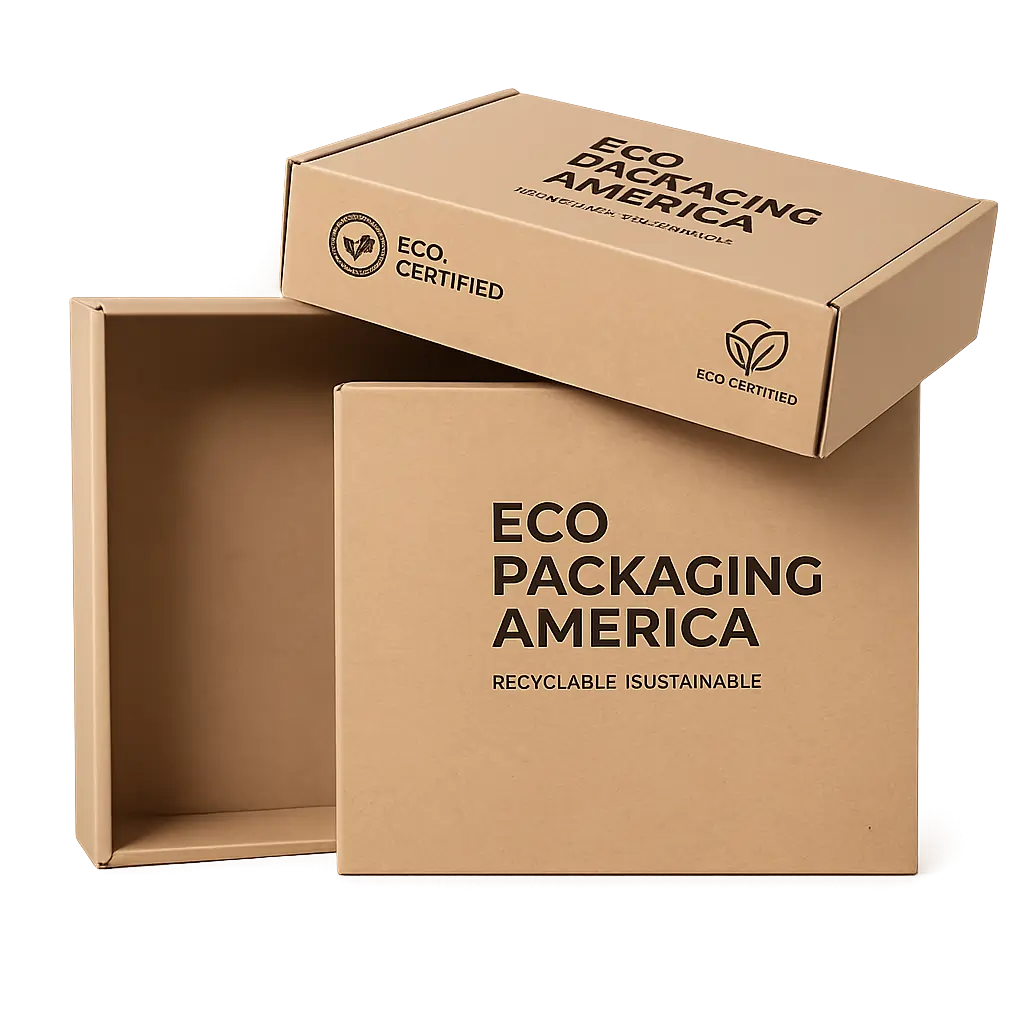
Eco-friendly bakery packaging resists grease and moisture while still being environmentally friendly. Materials like kraft paper, recycled cardboard, and molded pulp replace plastic and foam, yet still keep croissants, cakes, and bread fresh.
Because the food touches the box, these materials also need to be food-safe. In the US, the FDA regulates paperboard, inks, and coatings that contact food under 21 CFR Parts 174–186, so a good supplier should be able to confirm food-grade materials and a grease-resistant liner for oil-rich items.
Eco Packaging America prefers and recommends eco-friendly options, but we never pressure clients into them. Our job is to supply high-quality custom packaging — the final choice is always yours, whether that’s custom paper packaging, cardboard bakery boxes, rigid bakery boxes, or fully eco-friendly bakery packaging. Today’s customers expect a “fresh and natural” brand image, and that’s exactly what sustainable packaging delivers.
Plastic Packaging Restrictions Around the World
This isn’t one global law — every market has its own rules. If you’re designing packaging for a specific country, check that country’s regulations first. Here’s where the major markets stand:
| Region | Current status (as of 2026) |
| United States | No single national ban. States including California, New York, Oregon, Washington, New Jersey, and many cities enforce their own single-use-plastic laws. |
| European Union | The Packaging and Packaging Waste Regulation (PPWR, Reg. 2025/40) entered into force 11 Feb 2025 and applies generally from 12 Aug 2026, with staged rules through 2030+ on recyclability, recycled content, and labelling. |
| United Kingdom | Plastic Packaging Tax plus bans/charges on single-use plastics; UK exporters must also meet EU PPWR to sell into the EU. |
| Canada | Federal restrictions on certain single-use plastics and broader packaging reforms continue to shape material choices. |
Our team researched this through official regulatory sources (the EU’s own PPWR guidance and US state legislation) before publishing. The takeaway for bakeries: regulation is moving in one direction — toward less plastic — so sustainable packaging is the future-proof choice.
How Eco-Friendly Bakery Packaging Became the Standard
Walk into almost any bakery today and you’ll notice something different about the boxes, bags, and wraps on the counter. Kraft brown has replaced glossy plastic. Paper trays have replaced foam. What used to be a niche, “nice-to-have” choice is quickly becoming the default.
What the data actually shows
A quick honesty note: the exact “share of bakery packaging that is sustainable” varies a lot between research firms, because each defines the market differently — so we’ll skip the false-precise numbers and stick to what’s well supported.
- The market is growing fast. The US sustainable packaging market was worth about $49 billion in 2024 and is projected to reach roughly $74 billion by 2034 — around a 50% jump — with paper and fiber-based formats leading (Towards Packaging).
- Consumers will pay for it. About 41% of US consumers say they’d pay more for products in sustainable packaging (Two Sides), and global surveys put the share willing to pay a premium even higher.
- Big bakeries are already moving. Bimbo Bakeries USA, one of the largest baking companies in the country, reports that around 90% of its packaging is now recyclable — a signal of where the whole industry is heading.
- Regulation is pushing the same way. With plastic laws tightening across US states, the EU, the UK, and Canada, sustainable formats aren’t just popular — they’re becoming the compliant default.
Put those together and the direction is unambiguous: within the next decade, sustainable bakery packaging shifts from common to standard.
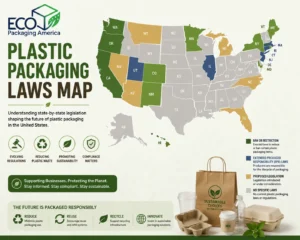
States Leading the Shift
Adoption is fastest where policy and consumer demand pull in the same direction. These states — most with active single-use-plastic restrictions or packaging producer-responsibility laws — are where bakeries are switching soonest:
- California — sets the national pace: the first state to ban plastic bags (2016), and under SB 54 all single-use packaging must be recyclable or compostable by 2032.
- Oregon — followed Maine with its own packaging producer-responsibility law in 2021 and banned foam foodware, steering bakeries toward recyclable materials.
- Washington — pairs a statewide plastic-bag ban with a packaging EPR program that shifts recycling costs onto producers.
- Maine — the first US state to pass an EPR packaging law (2021) and the first to ban foam food containers, making sustainable packaging the practical default.
- Colorado — banned single-use plastic bags and foam containers (fully enforced in 2024) and adopted its own producer-responsibility program.
- New York — one of the earliest big states to ban single-use plastic bags (2020), with New York City also restricting foam foodware.
- Hawaii — has no single statewide statute, but because every county bans plastic checkout bags, it effectively operates as a statewide ban.
- Connecticut — phased out single-use plastic bags with a fee-then-ban approach, moving retailers toward paper and reusables.
- Vermont — one of the broadest laws in the country, restricting plastic bags, foam food containers, and plastic stirrers and straws.
- Maryland — an early mover on banning foam foodservice products, now backed by a statewide packaging producer-responsibility program.
These states combine plastic-reduction or producer-responsibility laws with strong consumer demand — this reflects policy and market momentum, not a formal adoption ranking. Rules vary by city, so always check local requirements.
Benefits of Switching to Eco-Friendly Bakery Packaging
Beyond doing right by the planet, the switch pays off in practical, business terms:
| Factor | Traditional Plastic | Eco-Friendly (kraft / pulp / board) |
| Decomposition | Decades to centuries | Biodegradable or recyclable |
| Regulation risk | Rising bans (US states, EU, UK, Canada) | Compliant and future-proof |
| Brand image | Generic, dated | “Fresh and natural,” premium |
| Freshness / grease | Good | Good — engineered kraft, pulp, and liners |
| Consumer preference | Declining | Rising (≈41% of US buyers pay more) |
| Long-term cost | Volatile, exposed to plastic rules | Competitive and falling as demand grows |
Common Eco-Friendly Materials Compared
Not every sustainable material suits every job. Here’s how the main options stack up for bakery use:
| Material | Best For | Grease / Moisture | Eco Profile |
| Kraft paper | Boxes, bags, everyday items | Good with a food-grade liner | Recyclable & biodegradable |
| Corrugated cardboard | Shipping, heavier cakes | Good | Recyclable |
| Molded pulp | Trays, inserts, protective packing | Good | Biodegradable / compostable |
| Seed paper | Tags, cards, inserts (not grease contact) | Not for direct food contact | Plantable & biodegradable |
| Jute / cotton | Reusable bags, premium gifting | Not for direct contact | Reusable & biodegradable |
Expert Tips at a Glance
| Five things we tell every bakery going green
1. Match material to the job: kraft or pulp for food contact, seed paper only for tags and inserts. 2. Confirm food-grade materials and a grease-resistant liner for oil-rich items (21 CFR 174–186). 3. If you sell into the EU, check PPWR requirements before finalizing artwork and materials. 4. Lead with a clear, honest claim on the box (“100% recyclable kraft”) — skip vague “eco” badges. 5. Start with your highest-volume item, prove it, then roll sustainable packaging across the range. |
Key Takeaways
- Eco-friendly bakery packaging is grease- and moisture-resistant and sustainable — kraft, recycled cardboard, and molded pulp instead of plastic and foam.
- Plastic rules are tightening worldwide: US states, the EU’s PPWR (applies Aug 2026), the UK, and Canada.
- The US sustainable packaging market is projected to grow ~50% to about $74 billion by 2034 (Towards Packaging).
- About 41% of US consumers pay more for sustainable packaging, and major bakeries like Bimbo are already ~90% recyclable.
- Confirm food-grade, grease-resistant materials before ordering (FDA 21 CFR 174–186).
- Sustainable packaging is shifting from common to standard within the decade.
We Deliver Nationwide — With Free Shipping
One more thing worth mentioning: we don’t only make recyclable bakery boxes — we manufacture the full range of bakery packaging solutions. We deliver to bakeries in Los Angeles, San Diego, San Francisco, Miami, Houston, Phoenix, Boston, and across the entire United States, with free shipping included.
We don’t charge separate prices for packaging and shipping. Every quote we provide is built around printed custom packaging with free shipping and no hidden charges.
Frequently Asked Questions
What is eco-friendly bakery packaging?
Eco-friendly bakery packaging is grease- and moisture-resistant packaging made from sustainable materials like kraft paper, recycled cardboard, and molded pulp. It’s designed to keep baked goods fresh while reducing environmental impact, replacing plastic and foam. For anything that touches food directly, the material should also be food-grade and, for oil-rich items, grease-resistant so nothing bleeds through or softens the box.
Why is eco-friendly bakery packaging becoming the industry standard?
Three forces are pushing the same direction: rising consumer demand for sustainable products, tightening plastic regulations across the US states, EU, UK, and Canada, and stronger brand-image benefits for bakeries that switch. As plastic gets restricted and customers increasingly favor greener brands, sustainable packaging moves from a nice-to-have to the default, compliant choice for most bakeries.
Is eco-friendly packaging as effective as plastic at keeping food fresh?
Yes. Materials like grease-resistant kraft paper and molded pulp are engineered specifically to resist moisture and maintain freshness, much like plastic — without the environmental downside. For oily or refrigerated items, a food-grade liner or coating adds extra protection. The key is matching the material and any liner to the product, which a good packaging supplier can help you do.
What materials are used in sustainable bakery packaging?
Common materials include kraft paper, corrugated cardboard, and molded pulp for boxes, trays, and inserts, plus seed paper for tags and cards and jute or cotton for reusable bags. Kraft, corrugated, and molded pulp handle direct food contact when food-grade; seed paper and fabric are better suited to tags, inserts, and reusable carriers rather than grease contact.
Are recyclable bakery boxes more expensive than plastic packaging?
The cost difference is generally small and keeps shrinking as demand grows and plastic faces more regulation. Many bakeries find the brand value, customer trust, and future-proofing outweigh a modest price gap — and per-unit costs fall with volume. As plastic bans spread, sustainable materials are increasingly the more stable long-term choice, not just the greener one.
Do all countries have the same plastic packaging restrictions?
No. There’s no single global law — rules vary by country and even by state or city. The EU’s PPWR applies broadly from August 2026, the UK and Canada have their own restrictions, and in the US individual states like California and New York set their own laws. Always check the specific local requirements before finalizing packaging for any market.
What share of the bakery packaging market is now sustainable?
Estimates vary widely between research firms because each defines the market differently, so a single precise figure isn’t reliable. What’s clear is the direction: analysts agree sustainable formats are moving from niche to mainstream and are the primary growth driver. The broader US sustainable packaging market is projected to grow around 50% to roughly $74 billion by 2034 (Towards Packaging).
Does Eco Packaging America only offer eco-friendly packaging?
No. We supply a full range of custom packaging — including paper, cardboard, rigid, and eco-friendly bakery boxes. We recommend sustainable options because that’s where the market and regulations are heading, but the final choice is always up to you. Our job is to supply high-quality packaging that fits your product, budget, and brand, sustainable or otherwise.
Which US states are leading the shift to eco-friendly packaging?
States that combine plastic-reduction policies with strong consumer demand are moving fastest — including California, Oregon, Washington, Maine, Colorado, New York, Hawaii, Connecticut, Vermont, and Maryland. This reflects policy and market momentum rather than a formal adoption ranking, and local rules vary by city, so bakeries should confirm their own state and county requirements.
Does Eco Packaging America offer free shipping on custom bakery boxes?
Yes. We provide printed custom packaging with free shipping across the United States, including cities like Los Angeles, San Diego, San Francisco, Miami, Houston, Phoenix, and Boston — with no hidden charges. Packaging and shipping are quoted together as one transparent price, so there are no surprise delivery fees added later in the process.
The Bottom Line
Eco-friendly bakery packaging isn’t a passing trend — it’s where the whole industry is heading, pushed by consumer demand, tightening plastic laws, and real brand-image gains. Materials like kraft, recycled cardboard, and molded pulp now protect your product as well as plastic did, while telling a “fresh and natural” story your customers actually want.
| Ready to make the switch?
At Eco Packaging America, we help US bakeries move to sustainable packaging without guesswork — food-grade, grease-resistant materials, low minimums, samples, and free nationwide shipping with no hidden charges. Tell us your products and quantities, and we’ll send a no-pressure quote and a material recommendation. Request your free custom bakery packaging quote today. |
About the Author
Eco Packaging America — Packaging Team. Custom Eco-Friendly Packaging Specialists for US Markets. With over 5 years of experience producing custom eco-friendly packaging for US food brands, bakeries, and e-commerce businesses, we’ve helped 200+ American brands create packaging that sells. We specialize in sustainable kraft, rigid, and mailer box solutions with low minimum orders and fast turnaround.