
Halloween has one date. October 31st doesn’t move, doesn’t get extended, and doesn’t care if your packaging order is running behind. That’s what makes Halloween packaging different from most business decisions — there’s no “we’ll catch up next quarter.” Either the boxes are ready, or they’re not.
The businesses that get Halloween packaging right every year usually aren’t luckier than the ones that scramble. They have a real calendar, built backward from their shelf date, instead of a vague plan to “order sometime in the fall.”
Quick Answer
Start planning Halloween packaging in June, finalise artwork in July and August, and approve your final proof by the end of August. Production and delivery take approximately 12–15 business days from artwork approval, with shipping included — so boxes arrive in September with time to pack and stock shelves before October. Production itself is only about three weeks of the calendar. The rest is decisions, and decisions are what slip.
Planning for Halloween 2027
If you’re reading this in October 2026, the window for new custom production before this Halloween has closed: artwork needed approval by around 8–9 October to arrive in time. If you’re short on packaging right now, our rush Halloween packaging guide covers the options that still work, from printed sleeves on plain boxes to moving your budget to Christmas.
This calendar is for next year. Bookmark it, and come back in June.
Packaging Is a Chain, Not a Task
Many business owners think of packaging as one step: “order the boxes.” In reality it’s a chain of stages — deciding what you need, designing it, proofing it, producing it, and getting it onto shelves — and each one can only start when the one before it is finished.
Think of it like a relay race. Each runner can only start once the baton is in their hand. A slow first leg doesn’t get made up by the others trying harder; the whole team just crosses the line later. If your design approval slips by two weeks, everything after it slips by two weeks too.
The good news is that the slowest legs of this race are the ones you control. Once artwork is approved, production and delivery run on a fairly fixed clock of about three weeks. Everything before that point depends on how quickly you make decisions.
The Month-by-Month Halloween Packaging Calendar
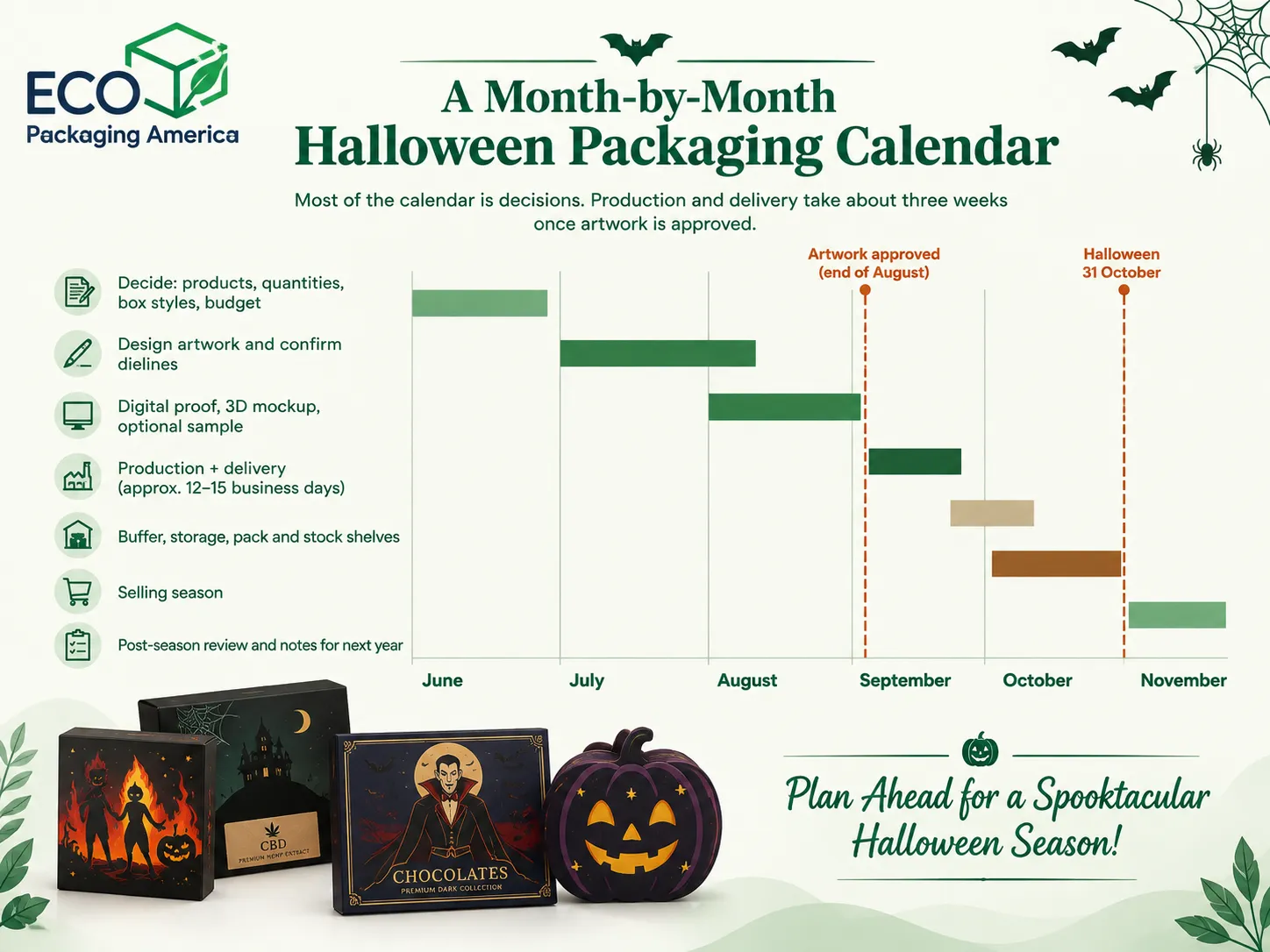
Month-by-month Halloween packaging calendar: decide in June, design in July and early August, proof and approve in August, production and delivery of approximately 12 to 15 business days in September, buffer and shelf stocking in late September, selling season in October, and a post-season review in November
Chart 1: A planning calendar working back from 31 October. Production and delivery take approximately 12–15 business days from artwork approval.
June: Decide What You Need
June is for decisions, not design. Review last Halloween’s sales, choose which products get seasonal packaging, and settle on a rough quantity range and budget. Pick your box styles now — tuck-end boxes, treat bags, mailers, window boxes, or a custom shape — because the structure shapes everything that follows. If you’re unsure how many to order, our seasonal packaging MOQ guide walks through sizing a seasonal run.
July: Design the Artwork and Structure
With styles chosen, design begins: logo placement, colour scheme, and the Halloween artwork itself. This is also when dielines are confirmed. If you want a custom die-cut shape like a pumpkin, coffin, or haunted house box, decide in July, because a new dieline has to be built and checked before the artwork can be fitted to it.
August: Proof, Sample, and Approve
August is for checking. Review the digital proof and 3D mockup at actual size, confirm every line of text, and make sure nothing important sits on a fold. If you want a physical sample before committing to a full run, this is the month for it. Aim to approve final artwork by the end of August. That single date is the most important one on the whole calendar.
September: Production and Delivery
Once artwork is approved, production and delivery take approximately 12–15 business days, with shipping to all 50 states included. On this calendar, boxes arrive by mid-to-late September — and because the timeline includes delivery, there’s no separate freight stage to add on top.
Late September to October: Pack, Stock, and Sell
The weeks after delivery are your buffer. Store the boxes, brief your team, pack products, and have stock on shelves or ready to ship as October begins. If anything went wrong earlier in the calendar, this is the slack that absorbs it.
November: Review and Write It Down
Once Halloween is over, spend an hour recording what sold, what ran out, which boxes worked, and what you’d change. Next June’s decisions will take half the time. By this point your Christmas packaging should already be ordered — the same calendar logic applies, just shifted forward by two months.
What Happens When One Stage Slips
A slipped stage doesn’t just delay itself. It shortens every stage after it, and the place that ends up squeezed is almost always the buffer at the end.
The most common slips are predictable:
- Artwork approval drifts because several people need to sign off and nobody owns the decision.
- Dimensions change after the dieline is built, which sends design back a step.
- The quantity decision is left open until after design, so the order can’t be confirmed.
The fix is simple, if not always easy: nominate one person to approve proofs, confirm dimensions before design starts, and settle quantities in June.
Adjust the Calendar for Your Box Type
Not every Halloween box needs the same lead time. Production takes about the same time once artwork is approved; what changes is how much design and checking happens before that point.
| Box type | When to decide | Why |
| Standard tuck-end boxes, treat bags, mailers | By July | Existing dielines; only the artwork is new |
| Custom die-cut shapes (pumpkin, coffin, haunted house) | Early July | A new dieline must be built and checked before artwork is fitted |
| Specialty finishes (foil, embossing, spot UV) | By early August | Extra proofing to place each finish correctly |
| Rigid and magnetic boxes | June to early July | More components to specify, sample, and approve |
If you’re running late in any year, the simplest way to protect your date is to put the Halloween personality into the artwork, not the structure. Strong seasonal print on a standard box often looks better on a shelf than a custom shape that arrives too late.
How Quantity Affects the Calendar
Larger orders need more press time and more quality checks, so a full seasonal run should be confirmed early. Ask for a delivery estimate at your quantity before committing.
Quantity also decides whether you’ll need a reorder — and a reorder is the most expensive slip on the calendar. It restarts the production clock in the middle of your busiest weeks. Ordering slightly more than your forecast, or planning a second run from the start, is usually cheaper than an emergency reorder in mid-October.
Common Timing Mistakes
- Treating “order the boxes” as one task instead of a sequence of decisions with their own deadlines.
- Planning backward from 31 October instead of the shelf date. If you want product displayed in late September, that’s the date to count back from.
- Underestimating quantity and needing a reorder mid-season.
- Not asking whether a quoted timeline includes delivery. Packaging produced overseas and shipped by ocean freight can spend several weeks in transit on top of production. Always confirm the date the boxes reach your door.
- Skipping the proof review to save a day, then needing a full reprint because a logo or a line of text was wrong.
Planning Early vs Starting Late
The interesting thing about a late start is that production doesn’t get much faster. What disappears is everything around it.
| Planning from June | Starting in September or later | |
| Production and delivery | ~12–15 business days from approval | ~12–15 business days from approval |
| Custom die-cut shapes | Comfortable | Risky unless decided immediately |
| Specialty finishes | Comfortable | Tight |
| Physical sample | Time available | Usually skipped |
| Room for design changes | Several rounds | One round, if any |
| Cost | Standard pricing | Rush production may add cost |
| Buffer before Halloween | Several weeks | Little or none |
Starting late can still work — see our Halloween packaging deadlines for the cut-off dates — but every option you lose comes from the decision stages, not the factory.
Build Your Own Calendar in Five Steps
- Set your shelf date. The day you want product displayed or ready to ship, not 31 October.
- Count back about three weeks for production and delivery from artwork approval.
- Subtract a buffer of one to two weeks for storage, packing, and anything that goes wrong. The result is your artwork approval deadline.
- Count back four to six weeks for design and proofing — longer for custom shapes, specialty finishes, or rigid boxes.
- Put a decision date in June for products, quantities, and box styles, and write every date in your team calendar.
How We Help You Keep the Calendar
- Free design support — our team helps with artwork and dielines, so the design stage moves faster.
- Digital proofs and 3D mockups — you see exactly how the box will look before anything is printed.
- Production and delivery in approximately 12–15 business days from artwork approval, with shipping to all 50 states included.
- Clear dates up front — we tell you when your boxes will arrive based on your approval date, not an optimistic guess.
- Low minimums from 100 boxes, so a test run or a second seasonal run stays practical.
Planning next year’s Halloween packaging? Send us your products, quantities, and shelf date. We’ll map out the dates that work backward from it. Request a quote · sales@ecopackagingamerica.com
Pros and Cons of Planning Early
| Pros | Cons |
| Full access to custom die-cut shapes and specialty finishes | Requires committing to quantity and design months ahead |
| No rush costs | Boxes need storage until the season begins |
| A buffer for mistakes, delays, or design changes | Forecasts made in June can shift by October |
| Time for a physical sample before the full run |
Pros and Cons of Planning Late
| Pros | Cons |
| Still possible for standard box styles | Rush production may add cost |
| Useful when forecasts or product launches shift unexpectedly | Custom die-cut shapes rarely fit |
| Decisions are made with more current sales data | Little or no room for design changes or mistakes |
Frequently Asked Questions
When should I start planning Halloween packaging? Around June. That gives you a month for decisions on products, quantities, and box styles, July and August for design and proofing, and production in September. Starting in June doesn’t mean ordering in June — it means making the decisions that everything else depends on. Businesses with simple, repeat designs can start a little later, but June keeps every option open, including custom shapes and specialty finishes.
How long does the full Halloween packaging process take? From first decisions to boxes on your shelves, plan on about three months. Only around three weeks of that is production and delivery, which take approximately 12–15 business days from artwork approval with shipping included. The rest is deciding, designing, proofing, and building in a buffer. That’s why the calendar starts so early: the decision stages are the ones that take time and the ones most likely to slip.
When should Halloween packaging artwork be approved? For a comfortable calendar, by the end of August. That gives production and delivery time to finish in September and leaves several weeks to pack and stock before October. Later approval can still work for a 31 October deadline, but the buffer shrinks quickly. The exact cut-off depends on your shelf date — count back about three weeks for production and delivery, then subtract a week or two for buffer.
What happens if one stage of the calendar runs late? Every stage after it moves back by the same amount, because each one depends on the stage before finishing first. The time usually comes out of your buffer at the end, which is why a buffer matters. The most common causes are slow artwork sign-off, dimension changes after the dieline is built, and quantity decisions left open too long. Nominating one person to approve proofs prevents most of them.
Do custom die-cut Halloween boxes need a different calendar? They need an earlier start rather than a longer production stage. A custom shape such as a pumpkin, coffin, or haunted house box needs a new dieline built and checked before the artwork can be fitted to it, which adds time to the design stage. Decide on the shape by early July so the artwork and proofing still finish by the end of August. Standard tuck boxes and treat bags can be decided later.
Can I skip the sampling stage to save time? You can skip a physical sample, but don’t skip the proof review. A digital proof and 3D mockup let you check the design, text, and dimensions at actual size without waiting for a sample. Skipping that check is how logos end up on fold lines or text ends up misspelled across a full run. If your box is a new size or a custom shape, a physical sample is worth the extra time.
How does order quantity affect the production calendar? Larger orders need more press time and more quality checks, so a full seasonal run should be confirmed early and you should ask for a delivery estimate at your quantity. Quantity also determines whether you’ll need a reorder. A mid-season reorder restarts the production clock during your busiest weeks, so ordering slightly above forecast, or planning a second run from the start, is usually the safer choice.
What’s the difference between planning early and starting late? Production and delivery take about the same time either way — approximately 12–15 business days from artwork approval. What a late start removes is everything around production: time for custom shapes and specialty finishes, a physical sample, design revisions, and a buffer before Halloween. A late start may also mean paying for rush production. An early start keeps all of those options open at standard pricing.
Do I need to add shipping time to the calendar? It depends on your supplier, so always ask whether a quoted timeline runs to delivery or only to the end of production. Packaging produced overseas and sent by ocean freight can spend several weeks in transit, which needs its own space on the calendar. Our approximately 12–15 business days runs from artwork approval to delivery, with shipping to all 50 states included, so there’s no extra freight stage to plan for.
What’s the most common Halloween packaging timing mistake? Treating “order the boxes” as a single quick task rather than a sequence of decisions. The second most common is counting back from 31 October instead of the date you want product on shelves, which for many retailers is late September. Both lead to the same outcome: artwork approved too late and no buffer left when something goes wrong.
Can I reorder mid-season if I run out of boxes? Yes, but a reorder restarts production, so plan for another 12–15 business days from approval. If your artwork and specification are unchanged, the reorder moves faster than the original because there’s nothing to redesign or re-proof. To avoid a mid-season scramble, order slightly above your forecast or agree a second delivery date in advance for your best-selling item.
Does Eco Packaging America help plan the production calendar? Yes. Tell us your products, quantities, and the date you need packaging on shelves, and we’ll work backward to the artwork approval date that gets you there. Our team also provides free design support and digital proofs with 3D mockups, which helps keep the design and approval stages on schedule. Production and delivery take approximately 12–15 business days from approval, with shipping to all 50 states included.
Final Thoughts
A Halloween packaging production calendar isn’t really about production. Once your artwork is approved, the factory part takes about three weeks. The calendar exists to protect the decisions in front of it — what to sell, how many to order, what the box looks like — because those are the stages that drift when nobody has written down a date.
So start in June, approve artwork by the end of August, and treat the weeks after delivery as your safety net. Build the calendar once, save your notes in November, and next year’s Halloween packaging becomes a routine rather than a race.
About the Author
Eco Packaging America — Packaging Team. Custom Eco-Friendly Packaging Specialists for US Markets. We produce custom packaging for US food brands, bakeries, confectioners, chocolatiers, candle makers, and e-commerce businesses, specialising in sustainable kraft, rigid, and mailer box solutions with free design support and fast turnaround.