If you’ve ever ordered custom boxes for a holiday launch, you’ve run into one number that changes everything: the minimum order quantity, or MOQ. It’s the number your supplier won’t go below, and it decides whether a seasonal packaging run is a smart move or an expensive mistake.
Every autumn, bakeries, gift shops, candy brands, and retailers wrestle with the same question: how many boxes do I actually need to order? The answer isn’t the same for everyone, and getting it wrong in either direction costs real money.
This guide covers what MOQ means, what drives it, why seasonal runs need a different approach, and how to work out the right quantity using numbers you already have.
Quick Answer
MOQ is the smallest number of boxes a supplier will produce in one custom run. Our minimum is 100 boxes, with wholesale pricing tiers as volume rises. For a seasonal run, start from last season’s actual sales, add a buffer sized to how certain your demand is, and check the result against your storage and cash — not against the biggest price break on offer.
What Minimum Order Quantity Actually Means
A minimum order quantity is the smallest number of units a packaging supplier will produce in a single run. It isn’t an arbitrary number. It comes from setup: every custom design needs a dieline, a print setup, colour matching, and machine time. Those costs are the same whether you print 100 boxes or 10,000. Below a certain quantity, the setup costs more than the order is worth — which is why minimums exist.
Our own minimum is 100 boxes. Beyond that, pricing moves through volume tiers.
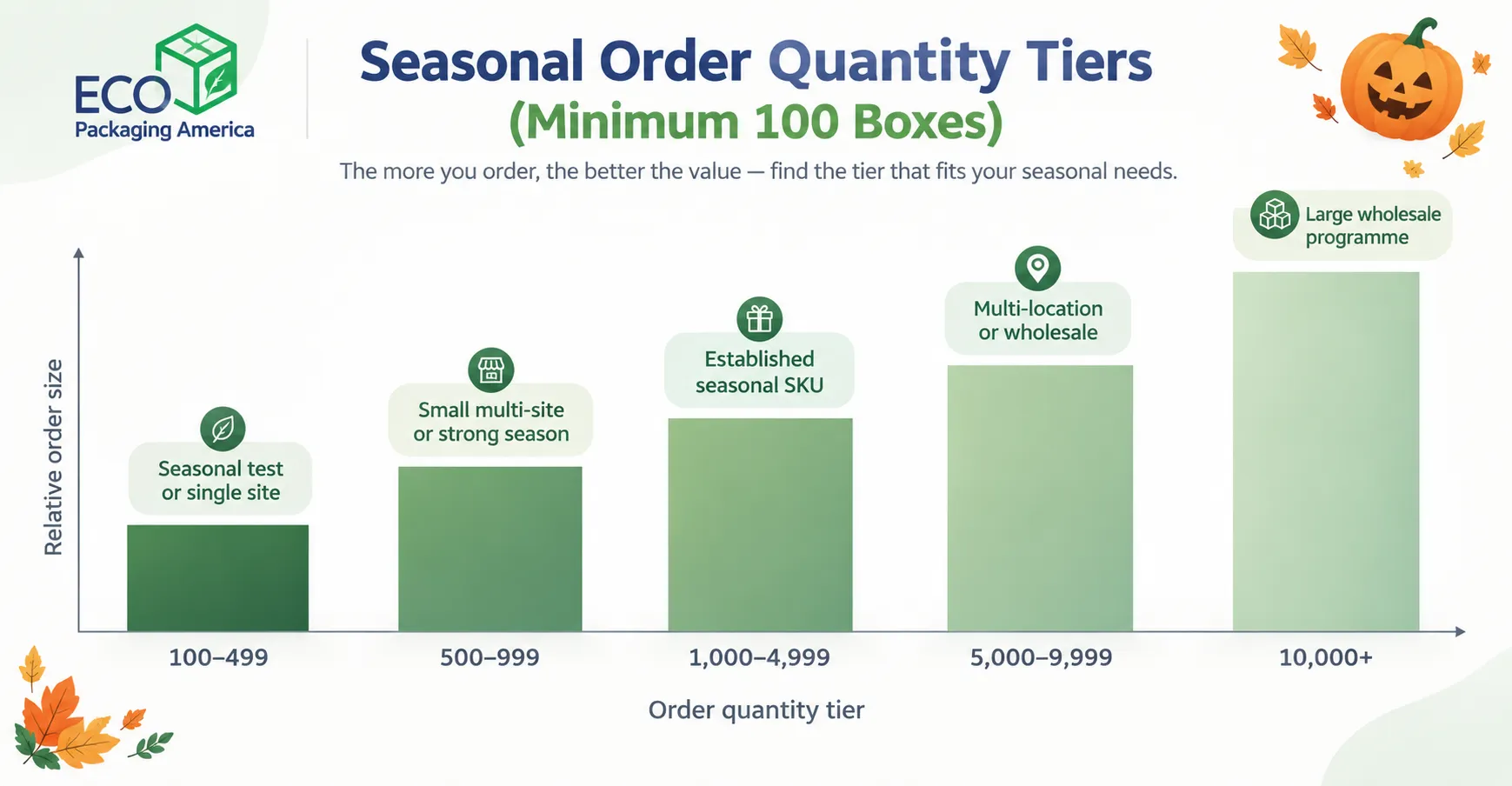
Bar chart showing seasonal order quantity tiers starting at 100 to 499 boxes and rising to 10,000 plus
Figure 1: Order quantity tiers for a seasonal run, starting at a 100-box minimum.
Why a Seasonal Run Plays by Different Rules
A year-round box gets ordered again and again. A seasonal box gets ordered once, used for a short window, and then it’s done. That changes the calculation in three ways.
The design expires, not just the stock. Leftover Christmas boxes can’t be sold in July. Over-ordering seasonal packaging doesn’t tie up cash temporarily — it can write it off.
Demand is confirmed late. Seasonal volume often isn’t clear until close to the season, leaving less time to commit comfortably to a large quantity.
Demand concentrates into a few weeks. Under-ordering risks running out during exactly the weeks that matter most.
So you’re trying to hit a sweet spot. Order too few and your per-box cost climbs, sometimes enough to eat your margin. Order too many and you’re storing or discarding holiday boxes in January. That’s why understanding quantity before you design anything — not after — saves both money and stress.
What Drives Your Per-Box Cost
Our 100-box minimum applies across styles, but the choices below change what each box costs — and at some suppliers, they also raise the minimum itself.
- Kraft and standard paperboard sit at the economical end. Rigid and specialty board use more material and labour.
- Printing method. Digital printing needs little setup and suits small seasonal runs. Offset needs more setup but becomes more economical and colour-consistent at higher volumes.
- Box structure. A simple tuck-end box is the most economical. A custom die-cut shape — a pumpkin, bat, coffin, or haunted house — needs a new dieline built, though we don’t add a separate tooling charge for it.
- Foil stamping, embossing, and spot UV each need their own setup and add to the unit cost.
- Number of colours. More ink colours mean more setup, particularly on offset.
The pattern matters more than any single figure: packaging pricing isn’t a straight line, it’s a curve.
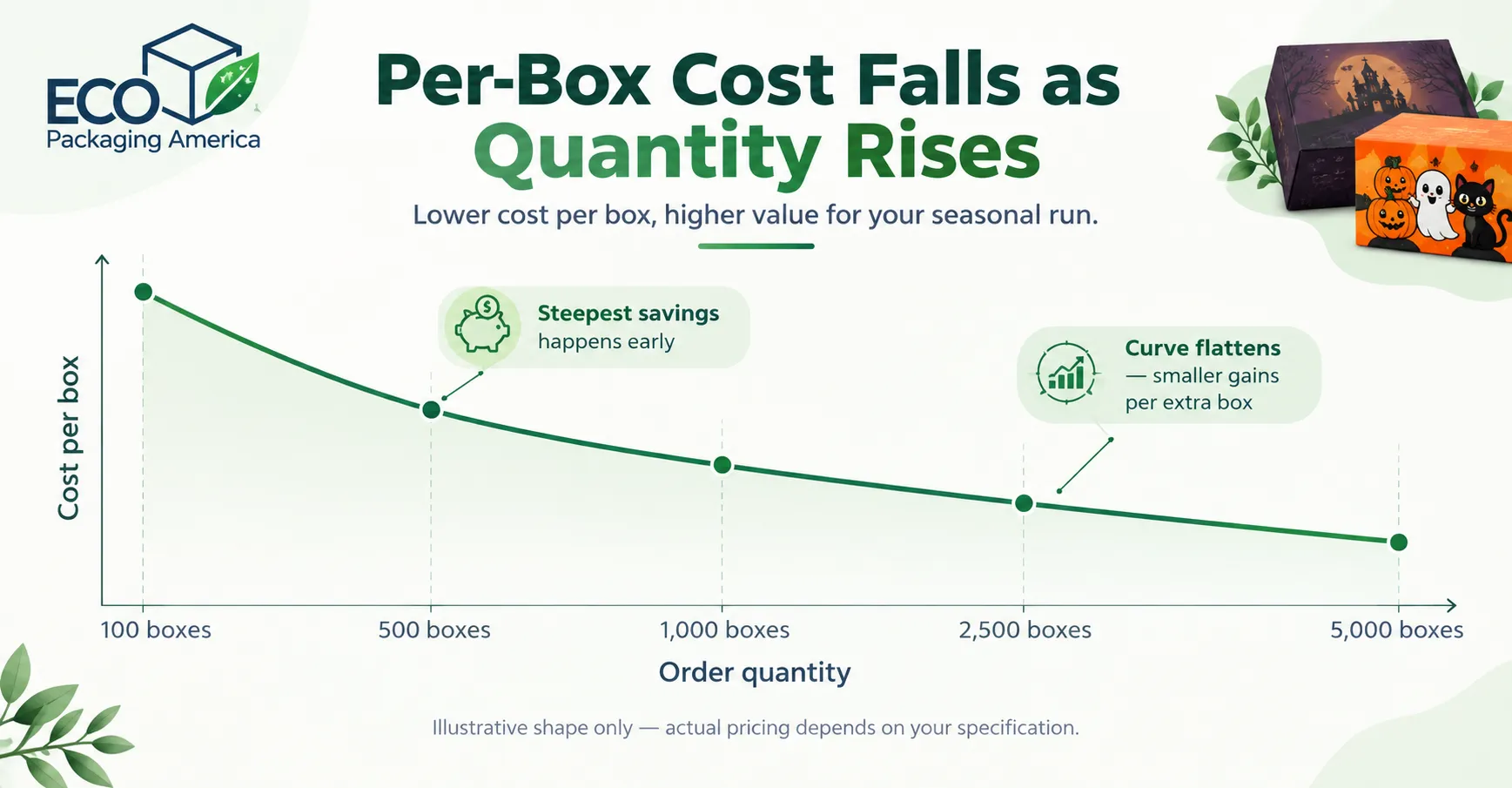
Line chart showing per-box cost falling steeply at low quantities and flattening at higher quantities
Figure 2: How per-box cost typically changes with quantity. Illustrative shape only — actual pricing depends on your specification.
Setup costs spread across every unit, so the steepest per-box saving comes in the jump from the smallest order to a moderate one. After that, the curve flattens: each extra box saves less. That’s why ordering “just enough” can cost noticeably more per unit than a slightly bigger, well-planned run — and also why chasing the lowest possible per-box price into a quantity you can’t sell rarely pays off.
How to Calculate Your Seasonal Quantity
- Pull last season’s actual sales for the same period. This is the single best predictor you have. If it’s your first season, take your weekly average and multiply by the length of the selling window.
- Add a buffer sized to your certainty. Around 5–10% if demand is stable and you’ve sold this product before; closer to 15–20% if it’s a first season, a new product, or you’re expecting a promotion to lift sales.
- Check your storage. Flat-packed boxes still take floor and shelf space, and seasonal stock arrives before you need it.
- Check your cash position. A larger order lowers the per-unit price but ties up more money before the season earns it back.
- Ask for pricing at three or four quantities, not one. Seeing where the curve flattens makes the decision far clearer than a single number.
- Compare to the minimum. If your number sits below it, consider a sleeve or label on a stock box before committing to a quantity you don’t need.
The point isn’t precision. It’s replacing a guess with a defensible number. Most over-ordering comes from anchoring to a price break rather than to demand.
How Much Lead Time You Need
MOQ and timing are connected: the less time you have, the fewer options you have to adjust quantity.
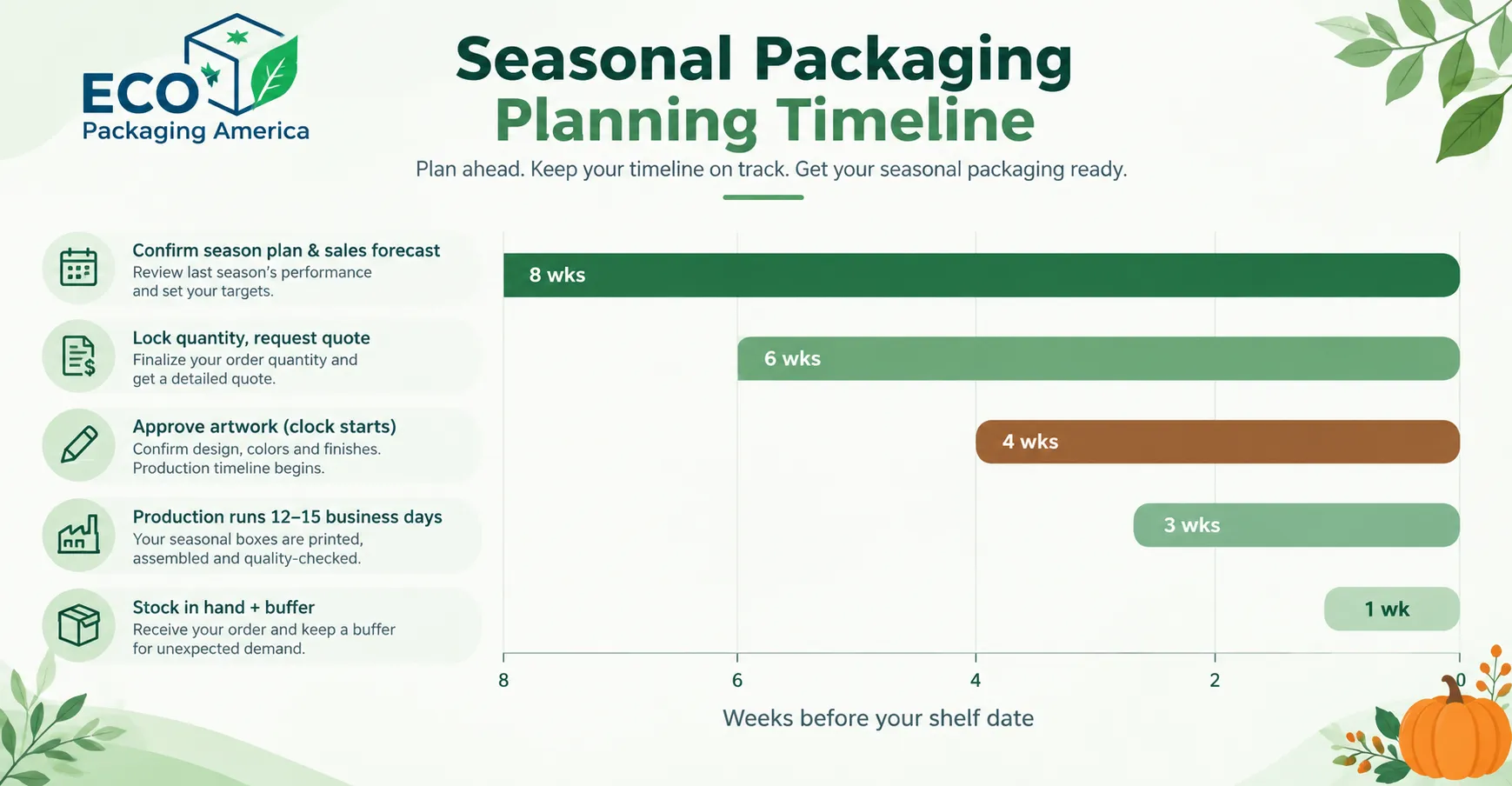
Horizontal timeline showing seasonal packaging planning from eight weeks before shelf date through to stock in hand
Figure 3: A comfortable seasonal planning timeline, working backwards from your shelf date.
Production and delivery run approximately 12 to 15 business days after final artwork approval — roughly three weeks. Everything before that is yours: confirming the plan, locking the quantity, and approving artwork. Around six to eight weeks before your shelf date is a comfortable runway. That isn’t eight weeks of production; it’s three weeks of production with room in front of it to decide without rushing.
Lower vs Higher Quantities
| Order approach | Pros | Cons |
| Low (100–500) | Less cash tied up · Lower risk if a design doesn’t sell · Good for testing a new style · Minimal leftover stock | Highest price per box · May need a reorder if demand is strong · Some finishes are harder to justify at small volume |
| Mid (500–1,000) | Balanced per-unit price · Comfortable buffer for most single-location businesses | Needs real storage space · Still a guess without sales data |
| High (1,000+) | Lowest price per box · One order covers the season · More printing and finishing options become economical | Largest cash outlay · Storage until the season starts · Real risk of unsold seasonal stock |
The honest framing: on year-round packaging, ordering up is usually right because the stock always gets used. On seasonal packaging it isn’t, because unsold stock has no second life. Let demand set the tier, not the price break.
Start Simple on Your First Run
If this is your first seasonal packaging run, a standard structure with strong seasonal artwork is a safer starting point than a fully custom shape. It moves through design and proofing faster, costs less per unit, and tells you what sells. Once you have a season’s data, stepping up to a custom shape or premium finish is a decision made on evidence rather than hope.
Common Mistakes
- Ordering on hope instead of last season’s numbers. The most common and most expensive mistake.
- Starting three weeks out. Production alone takes around three weeks, leaving no room for proofing or changes.
- Repeating last year’s quantity without checking last year’s sales.
- Chasing the lowest per-box price into a quantity you can’t sell. The cheapest box is worthless if half the run is discarded in November.
- Skipping a buffer entirely, then running out in the busiest week.
- Treating seasonal like a standing reorder. It has its own deadline, artwork, and shelf life.
Ways to Stay Under a Minimum
- Print a sleeve, belly band, or label instead of a full box. Keep a plain box year-round and apply the seasonal print to a cheaper component with a shorter lead time.
- Put the seasonal treatment on one hero product rather than the whole range.
- Choose a box size that works year-round, so the structure carries over even if the print doesn’t.
- Keep seasonal artwork date-free so surplus stock is usable next year.
- Reuse an approved design next season. Once a dieline and artwork exist, reorders skip setup, lowering both cost and turnaround.
What We Offer for Seasonal Runs
- A 100-box minimum, so testing a seasonal design doesn’t require a year of inventory.
- Wholesale pricing tiers as volume rises.
- Digital and offset printing options, matched to your quantity.
- Free design, dieline creation, and 3D mockups, so you see the box before production.
- Approved dielines kept on file, so a repeat order next season skips setup.
- Free shipping to all 50 states.
- Production and delivery in approximately 12–15 business days after artwork approval, with rush options where the date is tight.
Planning a seasonal run and unsure what quantity makes sense? Send us your box size, expected quantity, and target ship date. We’ll quote it at several quantities so you can see exactly where the pricing curve flattens for your specification. Request a quote · sales@ecopackagingamerica.com
Frequently Asked Questions
What does MOQ mean in packaging? MOQ stands for minimum order quantity — the smallest number of boxes a supplier will produce in one print run. It exists because every custom run carries fixed setup costs for the dieline, print setup, and colour matching, and those costs are the same whether you print 100 boxes or 10,000. Below a certain point the order doesn’t cover them. Minimums vary between suppliers, so always check the figure rather than assuming.
What is the minimum order for a seasonal custom box? Our minimum is 100 boxes for a custom printed seasonal design, with wholesale pricing tiers as quantity rises. That’s deliberately low, because a brand testing a new seasonal theme shouldn’t have to commit to a year of inventory to find out whether it sells. Minimums elsewhere in the industry vary considerably and are often higher for complex structures, so compare carefully when quoting.
Can I order fewer boxes than the minimum? Not usually for a fully custom printed run, because the setup cost doesn’t change with quantity. What often works instead is moving the seasonal element off the box: a printed sleeve, belly band, or label applied to a plain stock box gives you a seasonal look at a much lower commitment and a shorter lead time. It’s a genuinely good option for small producers rather than a consolation prize.
Does box material affect cost and minimums? Yes. Kraft and standard paperboard are the most economical materials, while rigid and specialty board use more material and labour and cost more per unit. At some suppliers, specialty materials also carry higher minimums. Our 100-box minimum applies across styles, but material still shapes your per-box price — so if budget is tight, a kraft or paperboard structure with strong seasonal artwork is usually the most efficient choice.
Is digital printing better for small seasonal runs? Usually, yes. Digital printing needs very little setup, which makes it well suited to smaller seasonal quantities and faster turnaround. Offset printing takes more setup but becomes more economical and gives highly consistent colour on larger runs. For most seasonal orders the right method follows naturally from quantity, and it’s something to settle with your supplier at quote stage rather than a decision you need to make alone.
Does adding foil stamping or embossing affect my order? Yes. Foil stamping, embossing, and spot UV each need their own setup, so they raise the per-unit cost and are proportionally more expensive on small runs. They’re often exactly what makes seasonal packaging look premium, particularly on dark Halloween or Christmas artwork. If quantity is low, consider applying a finish to one element — a logo, say — rather than across the whole design.
How far in advance should I place a seasonal order? Production and delivery take approximately 12 to 15 business days after final artwork approval. Allow time in front of that for confirming quantity, quoting, and approving a proof, so around six to eight weeks before your shelf date is comfortable. A tighter timeline still works, but the shorter the runway, the less room there is to adjust the quantity or change the design if something isn’t right.
How much buffer should I add to my order? It depends on how certain your demand is. If you’ve sold the same product before and demand is stable, around 5–10% above expected sales is usually enough. For a first season, a new product, or a planned promotion, 15–20% gives more protection against running out. Seasonal packaging makes over-ordering costlier than usual, because date-specific designs can’t be carried into the rest of the year.
Is it cheaper to order more boxes than I need? Per box, yes — setup costs spread across more units. But the saving only helps if you actually use the extra stock. On seasonal packaging, surplus boxes printed with a date-specific design often can’t be used after the season ends, which turns a per-unit saving into a total loss. Ask for quotes at a few quantities and look at where the price curve flattens rather than going for the largest break.
Can I test a new design with a small order first? Yes, and it’s usually the smart move before committing to a large seasonal run. A 100-box run lets you see how the design performs on shelf and whether customers respond to it, without tying up cash in inventory. If it sells well, the approved dieline and artwork stay on file, so scaling up next season skips setup and moves faster.
What happens if I run out of boxes mid-season? A reorder of an approved design is faster than a new order, because the dieline and artwork already exist, but it still needs production time — so it isn’t instant. The best protection is planning the right buffer in the first place. If you think demand could run well ahead of forecast, discuss a reorder plan when you place the first order rather than waiting until stock runs low.
What’s the biggest mistake businesses make with seasonal MOQs? Ordering on hope rather than evidence. Businesses anchor to an optimistic forecast or to the quantity that unlocks the best price break, and end up either running out during peak weeks or storing surplus boxes they can’t use. Starting from last season’s actual sales, adding a buffer sized to how certain demand is, and checking pricing at several quantities avoids both problems.
Final Thoughts
Getting MOQ right on a seasonal run isn’t about finding the lowest price per box. It’s about matching the order to demand you can actually evidence, then checking it against your storage and your cash before you commit.
Use last season’s numbers, size your buffer to how sure you are, and ask for pricing at more than one quantity so you can see where the curve flattens. A slightly higher per-box price on a quantity you sell out of beats a bargain on a run that half ends up in storage.
About the Author
Eco Packaging America — Packaging Team. Custom Eco-Friendly Packaging Specialists for US Markets. We produce custom packaging for US food brands, bakeries, confectioners, chocolatiers, candle makers, and e-commerce businesses, specialising in sustainable kraft, rigid, and mailer box solutions with free design support and fast turnaround.